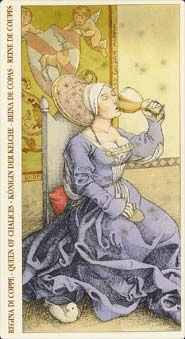
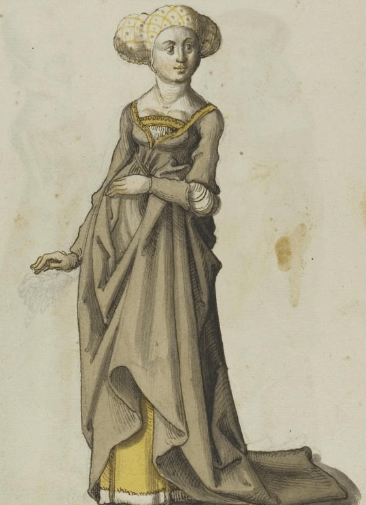
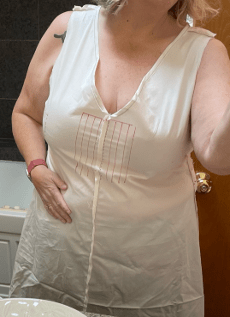
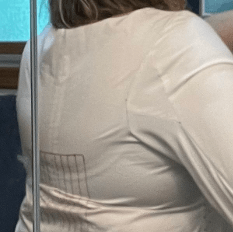
As a German re-enactor, I have been fascinated by the housebook/Dürer dress for years (also called the stehfaltenkleid in Germany). It’s such an odd evolutionary branch of women’s clothing. Dresses went from Swabian dress and, during the same time frame, the houppelande, to the brief, transitional housebook dress, and then morphed into the more structured, fitted bodice with pleated skirt of the German renaissance.
Rabbit Hole!
Let’s touch on body types and definitions of beauty in the 15th century. Beauty standards and body types vary throughout history, with round, voluptuous women seen as desirable in some periods, and slim women with a more girlish shape were the ideal in other periods. The fifteenth century, for better or worse, seems to have swung toward slim and girlish shape, with a narrow waist and breast that were “small, white, round like apples, hard, firm, and wide apart” – and that’s what we see in depictions of the housebook dress and other 15th century gowns in central Europe.
Not all bodies at that time were shaped like young adolescent girls, and certainly not all bodies in modern times are shaped uniformly, either. It can be a bit disheartening to spend a lot of effort on research, prototyping, construction, and accessorizing historic gown that just drapes and appears different on a different body type.
I am generally a body neutrality advocate; that philosophy focuses on what the body can do rather than how it looks. Body neutrality asks people to view their bodies as neutral tools or vessels that carry their mind, heart, and spirit through life. And through the lens of body neutrality, it matters not whether I look like the source portrait; what does matter is that I did my research and construction well, and that I wear the resulting historical garment proudly with contextual knowledge and cultural and self-respect.
The Housebook Dress in Art and Illustrations
The housebook dress appears in art and illustrations from roughly 1460-1500, across much of Germany and Bavaria, and occasionally a little further afield in Bohemia and the Netherlands. My conjecture is that it’s a merchant class and even lower noble class garment, given the relatively modest personal adornment seen in such portraits. (There are exceptions – some of the women shown in the housebook dress wear crowns.)
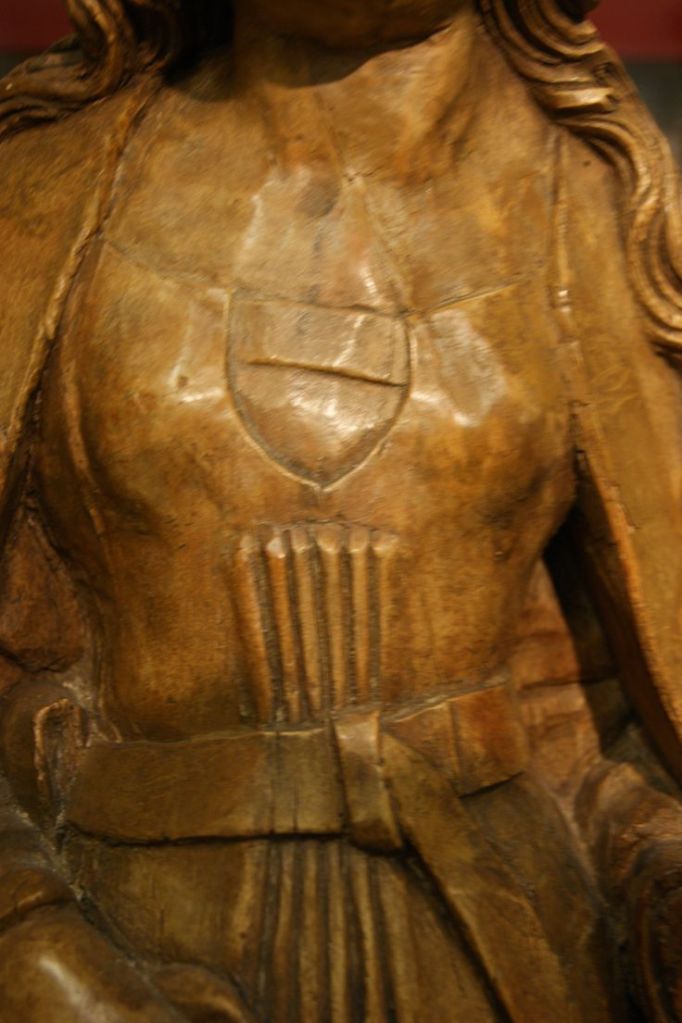
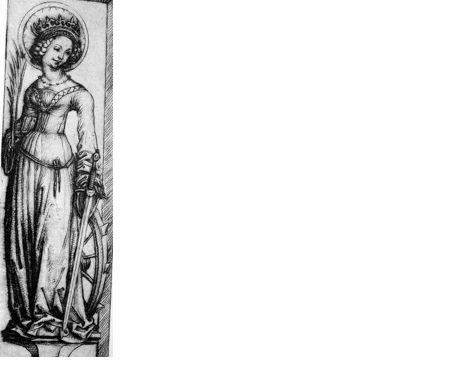
Various version of the dress seem to have many similarities – a deep vee or scoop neck, grouped pleats center front and center back, grande assiette sleeves either long or puffed and tied, and long, voluminous skirts. It was usually made of wool, or multi-layer with linen and a “fashion fabric” layer of wool.
Common accessories include:
Unseen but found in the archaeological record, 15th century German wore a skirted supportive garment modernly called the “Lengberg bra”, after the archaeological treasure trove found in Lengberg castle.
The linen hemd, the basic smock or shift, was always worn as an undergarment, and it ranged from simple and plain to elaborately pleated, smocked, and ornamented.
Some versions of the housebook dress show a placket or tie snugging down the wide housebook dress neckline at the collarbone level – a single cord or chain, multipe cords or chains, and even ornate plaque garters in a few instances.
Most women wore linen, wool, or silk headwear – often the wulsthaube and steuchlein, either plain, embroidered, or richly ornamented, along with cornets (temple braids) and occasionally gefrens (brightly colored fringe at the nape of the the neck). I have not seen any evidence of overlap between the kruseler (the frilled veil) and the housebook dress, but other wiser scholars may have found a correlation.
Some women wore slim belts with ornate metal buckles, and added belt bags of varying styles to carry their personal effects, but other women wore the dress without any belt.
There is some evidence that the goller – the shield-shaped German mantle – and the housebook dress overlapped and were worn together.
For cold weather, the typical women’s coat was called the schaube, a simple A-line wool coat with loose sleeves and optional fur collar and cuffs.
Construction Differences
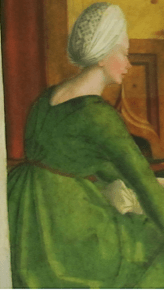
After all the similarities, there do seem to be some different versions of the housebook dress, as evidenced by contemporaneous illustrations and paintings.
Werkansicht: Das Sächsische Stammbuch – Mscr.Dresd.R.3, 1497, influenced by Lucas Cranach.
The Birth of the Virgin Mary (German: Die Geburt Marias), created around 1460–1480 by the anonymous Tyrolean artist known as the Master of Uttenheim
Fixed Pleats
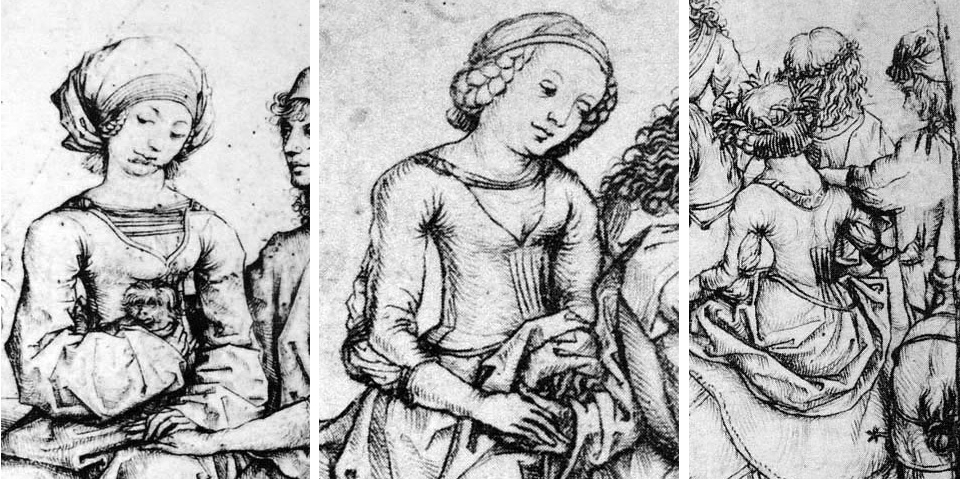
Then there are illustrations and paintings that seem to depict fixed pleats, perhaps even an inserted panel of pleats, on such gowns. This seems less intuitive a construction method, but would produce a trim fit through the waist and reliable pleating. This version seems to be secured by lacing between the pleats at the center front.
Meister des Hausbuches, Das Mittelalterliche Hausbuch, 1480
Limburg Cathedral Treasury, 1465
Fixed Waist Seam
There is a less frequently seen third version that also appears in paintings and illustrations, a dress with a fixed, structured bodice and an attached skirt, either smooth fitting or pleated itself. This would also require center or side lacing to produce the slim bodice fit depicted.
Meister des Hausbuches, Das Mittelalterliche Hausbuch, 1480
The Dance of Salome (c.1495-1500) by Master of the Carnation
My Process
While I have studied and want to someday aspire to the level of the Lengberg version of the housebook dress, that’s not where I wanted to take this particular project. Instead, my design choices were:
Build fixed pleats using an inserted panel
Add a (relatively unnecessary) waist seam
Close the dress with side lacing
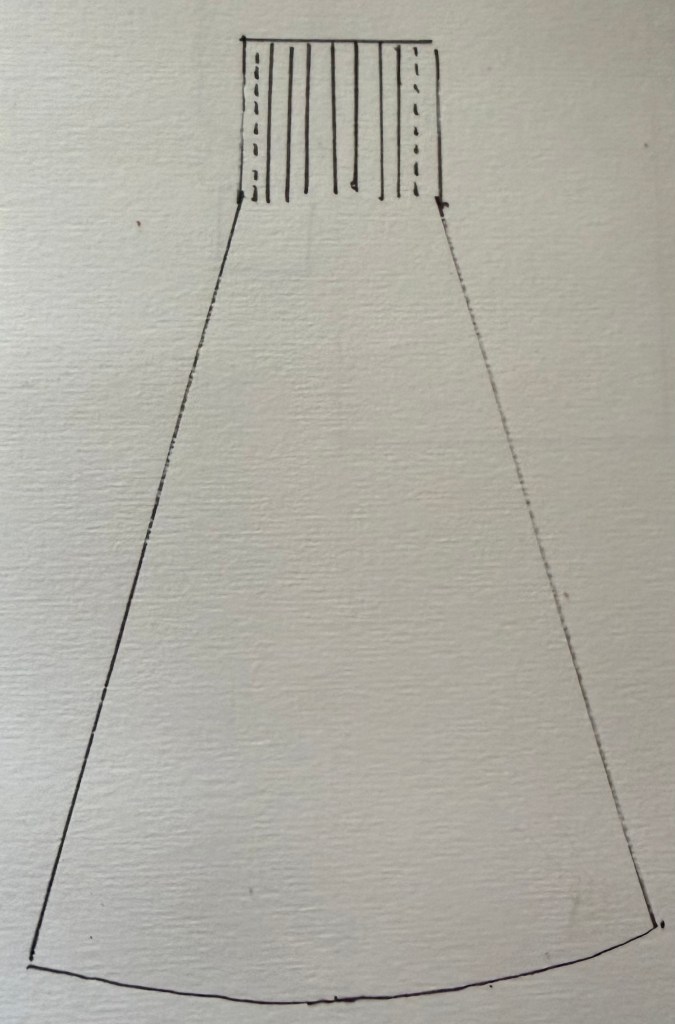
Achieve the voluminous skirt with wide cut skirts and side gores, to balance the pleated panels front and back
Make the neckline a deep vee, ending just above the pleats
Create grande assiette sleeve, full length, with ties at elbow and wrist to display my poufy hemd
I chose a soft, medium weight, light ochre wool herringbone. There’s not much evidence of herringbone being featured in 15th century clothing, but I had it on hand, I liked the soft hand and drape, and figured I could potentially overdye it later. (Narrator: dear reader, this is foreshadowing a future mishap.) I lined the pleats, bodice and sleeves with light yellow linen.
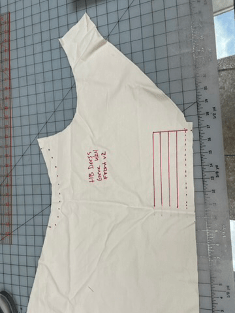
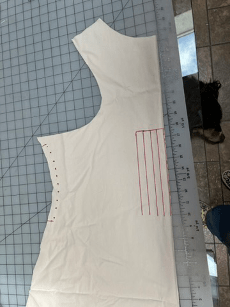
I started with my basic, well-fitting gothic fitted dress pattern. I cut the bodice back to a wide vee, stitched up a mockup, and then drew a grande assiette seam line on the mockup. I cut at the grande assiette line, and used that to extrapolate the larger sleeve head and necessary gores.
I created a second mockup, adding the sleeves, for fine tuning.
I then marked that up, lowering the pleat panels, enlarging the grande-assiette sleeves, and streamlining the fit – and disassembled and revamped it one more time. (I have no photos of mockup 3.)
I then started on the actual dress. I assembled the body, minus the pleat panels, and assembled the sleeves.
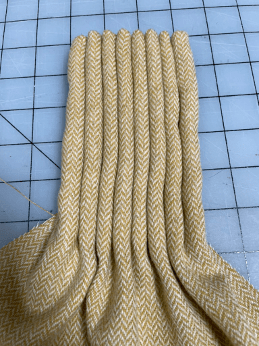
I counted the pleats on a number of housebook dresses in illustrations, and it seemed that 6 or 8 pleats was the most common number. I did some math – I wanted my pleats ½” deep, and I planned to pad them, so I made the pleat panel 18” across. I chose to give it a gore shape as well, for skirt movement. (Skirts must twirl!)
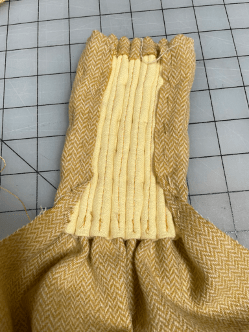
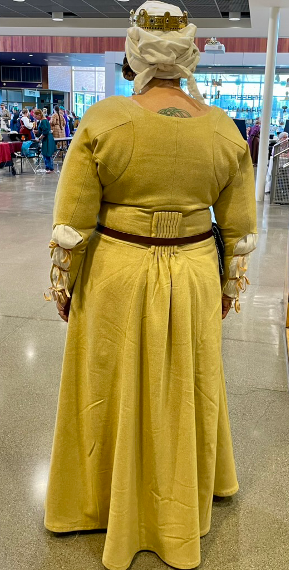
I put 2 layers of thin cotton batting over the pleat section, and then a layer of gold linen. I machine stitched in the pleat valleys, and turned under and whip stitched the edge of the linen, for a neat finish, leaving 1” wool free on the sides for finishing. I hand formed the pleats, and stitched them securely in place at 1” intervals with gold perle cotton. I made two, one for front and one for back.
I then managed an odd combination of securely whip stitching the cartridge of pleats in place over the top of the bodice, but then flipped the garment over and managed a classic machine seam, good side to good side, for the skirt. I did a little handsewing at the waistline to create a neat transition from the outside.
I chose to add side lacing to the bodice, which ended up being unnecessary, as did the waist seam.
I hemmed and finished it all, and added buttons just below collarbone level so I could add a tie snugging the neckline down.
The Debut
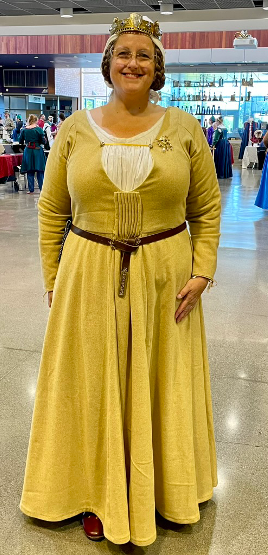
I wore the dress to our Athenaeum arts and sciences display event. I had always wanted to display, but as hosting baroness, or on hosting branch event team, it never worked out. At least I was able to wear one of my projects, as a sort of display!
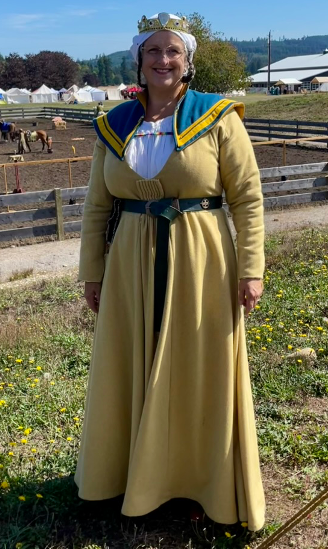
As a first iteration, I’m mostly happy with how it turned out. There are things I’d change: the pleate cartridge protrudes further than I like, the v-neck is a little too low, the waist seam is a couple inches too low, and I didn’t quite get the gore geometry right on the grande assiette sleeve – but it’s comfortable and historical and flattering.
I wore it again at Autumn War, wanting to pair it with my teal/gold goller. Oops – yes, the vee neck is too low, and/or the gollar too short. I managed to make it work with pins.
The Next Steps
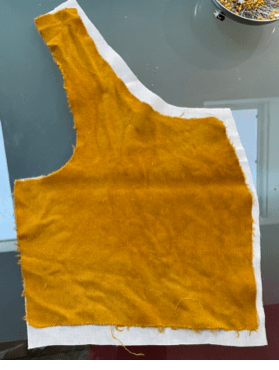
I decided to take it apart and rework the bodice, to resolve the pleat protrusion and raise the neckline. I had just enough fabric left for new bodice pieces.
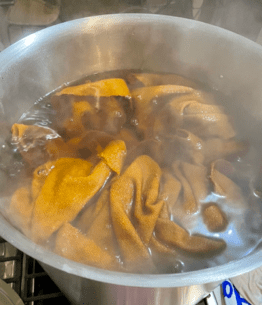
While I was at it, I decided to overdye the herringbone with a richer gold. (Which is silly, in hindsight – it is a great color.) This was the disaster I foreshadowed earlier.
I took everything apart, even the pleat cartridges and sleeves. I used acid-reactive dye, which has to stay at 185º F (85º C) for the duration of the dye bath. The dye pot was a little small for a dress this voluminous – the color distribution did end up a bit splotchy. Most importantly, though, while I was careful to agitate gently, so as not to full the wool, it still shrunk significantly from the hot water bath. The shrinkage in both length and width was a bit too much to work with, even with adding sizeable guards to the hem – so I had to give up on the project, with much sadness.
Next Next Steps
I do still have the pattern, and I do still want to master this particular garment! It’s a useful camping dress, and a good winter gown as well. I’m going to prototype it with higher neckline and lower profile pleats in linen this fall, and then make a lightweight wool version for 12th night – and add all the fancy accessories, as well.