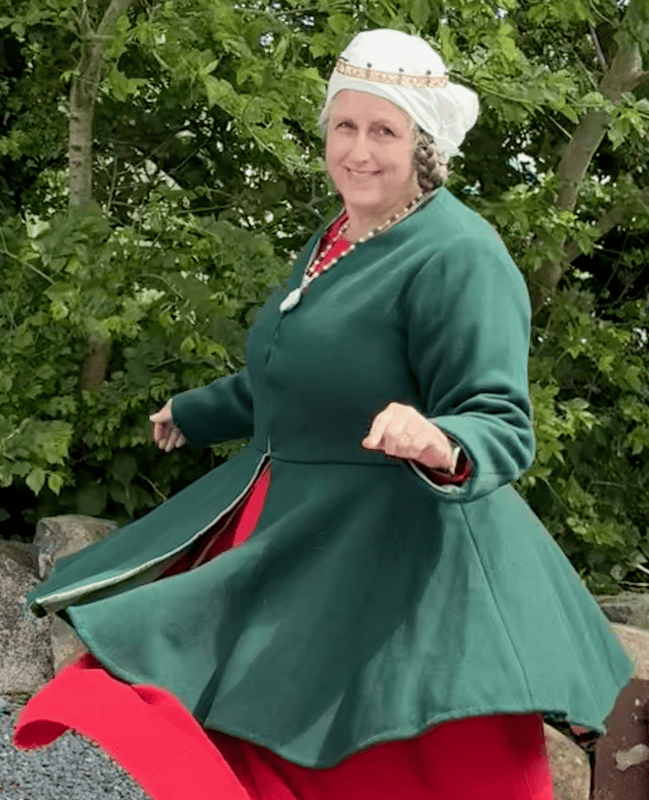
Last year, a friend (who is one of my 15th-16th ct German garb inspirations) made a very cute, practical short wool coat, specifically for wintertime outdoor archery. She shared some construction photos with me, and I was hooked.
Research
I dove in and began researching short coats. This coat, also called leib rock, showed up occasionally in prints and sketches dated from the late 15th ct through the mid 16th ct in southern Germany. Visual cues in the art seemed to identify them as working class garments. While there is one written record listing a leib rock in a burgherwoman’s inventory in the late 16th century, there is no record I am aware of where the coat was depicted on nobility.
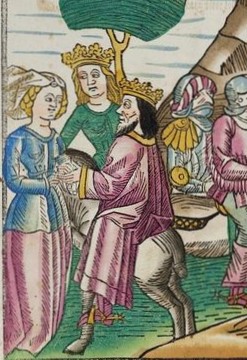
Giovanni Boccaccio, De claris mulieribus ( On Famous Women ), Ulm, 1473. The woman in the short coat seems to be a lady in waiting.
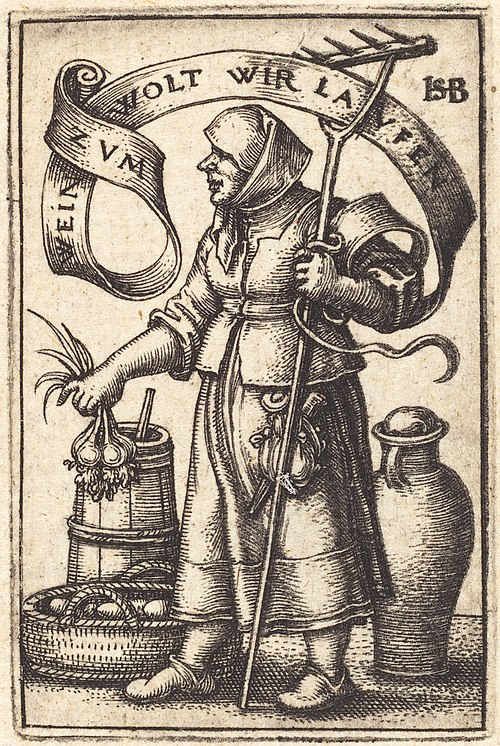
Sebald Beham, The Market Woman, 1542, National Gallery of Art
This woman appears to be farmer or a shopkeeper.
Rabbit Hole!
Precisely what is meant by the term “working class” here?
In the early and high middle ages, society was divided into three classes – the peasant class, the clergy, and the noble class. In the late middle ages and renaissance, as a culture of commerce grew, the classifications grew more nuanced: peasants, burgher/merchant class, clergy, and nobles. There was little class mobility available to the average person.
The term “burgher” seems to be roughly analogous to working class, although there was a huge variety of professions represented within it: artisans of all types, magistrates and scholars, and soldiers. Tradespeople, in particular, ranged from the simple laundress at the low end of skill and income, to goldsmiths and printers at the high end.
And how would we classify domestic service? This is one of the employment options that was readily available to women. The upper echelons of domestic service required high skill, education, and social graces, and yet were not exactly peasants nor burgher class. I don’t believe that peasants were considered working class, as they were not necessarily free citizens.
Women, in particular, did not fit well into with these categories and classes, and derived their class from their father or husband. Nobles did not practice a trade and were financially self-sufficient. Women in the upper strata of the burgher class likewise were self-sufficient, well-dowried, and did not need a source of income.
Women in the lower strata of the burgher class worked. They needed to find employment while young to earn a dowry, which could mean going into service or being employed in a subordinate role in a tradesman or artisan’s shop. Among the working class, marriage was predominantly a business arrangement, with dowries, businesses, and guild membership as factors. Women needed to marry a man whose trade would support a potential family, and depending on the trade, could give her opportunity to continue to work and train her daughters into the trade after her.
There were many currencies in circulation in 15th ct Germany. One of the most commonly used was that of the Rhineland, with the gold Gulden, worth 26 of the silver Grosschen, which in turn was worth 12 copper pfennig. Those numbers in isolation don’t mean much – let’s look at wages and purchasing power.
| Unskilled laborer | 1-2 pfennig/day plus basic room and board | 1 pfennig = a dozen eggs or a gallon of cheap beer |
| Master craftsman | Up to 1 grosschen/day | 1 grosschen = a pair of leather shoes or a chicken |
| Wealthy merchant/highly skilled craftsman | 30-60 gulden/year | 1 gulden = sheep, fine winter coat 4-6 gulden = workhorse or cow |
| Knight | Estate income – 50-100 gulden/year | 50 gulden – high quality warhorse |
| High noble/count | Estate income – 1,000+ gulden/year |
So, when we say a garment was for a working class woman, I assume that it might have cost somewhere between a groschen and a gulden, and signifies that its wearer worked in some capacity until, and perhaps after, marriage – whether on a farm , in service, in a shop, or in a trade. As a working class garment, it needed to be comfortable and practical, giving the wearer the ability to do physical labor and remain warm when outdoors in inclement weather.
Fabric
I found a beautiful 2 ½ m piece of a super-soft dark green cashmere-wool blend on clearance this spring, and I knew it wanted to grow up to be this coat. (Definitely much better than working class quality fabric!) I had a good-sized piece of pistachio linen in my stash that seemed perfect for lining. I chose not to interline the coat; I wanted to keep it soft and flexible for active wear.
My linen lining fabric is recycled linen. The texture is smoother than standard linen, its composition is possibly a little synthetic, and the fabric was likely woven from short staple fiber, and was strangely stretchy, drapey, and soft, even after prewashing and drying on hot. My initial thinking was that soft and drapey was fine for lining – but the stretchiness became a problem when I was attempting bag lining. I cut the linen out slightly smaller than the outer layer, but by the time I was tacking the bodice lining down, I ended up pleating a more than an inch of stretched excess linen back into the side seams.
Construction Process
Drei Schnittbucher has an excellent pattern for the leib rock in its womens clothing section. Did I start there? No, that would have been too easy! Instead, I started with my gothic fitted dress pattern. I added a couple inches ease to the overall and sleeve circumference, and raised the neckline to fit closely around my throat. The major difference between my pattern and the one in Drei Schnittbucher is that I made the sleeves from one pattern piece, not two. My tailor’s assistant was extremely helpful.
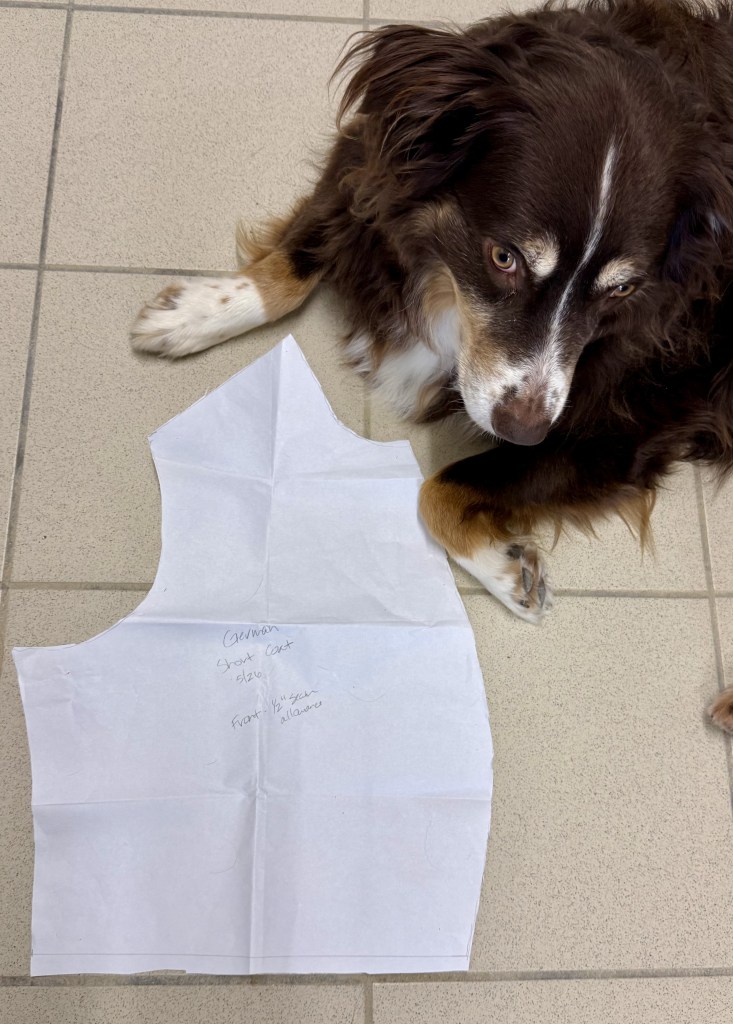
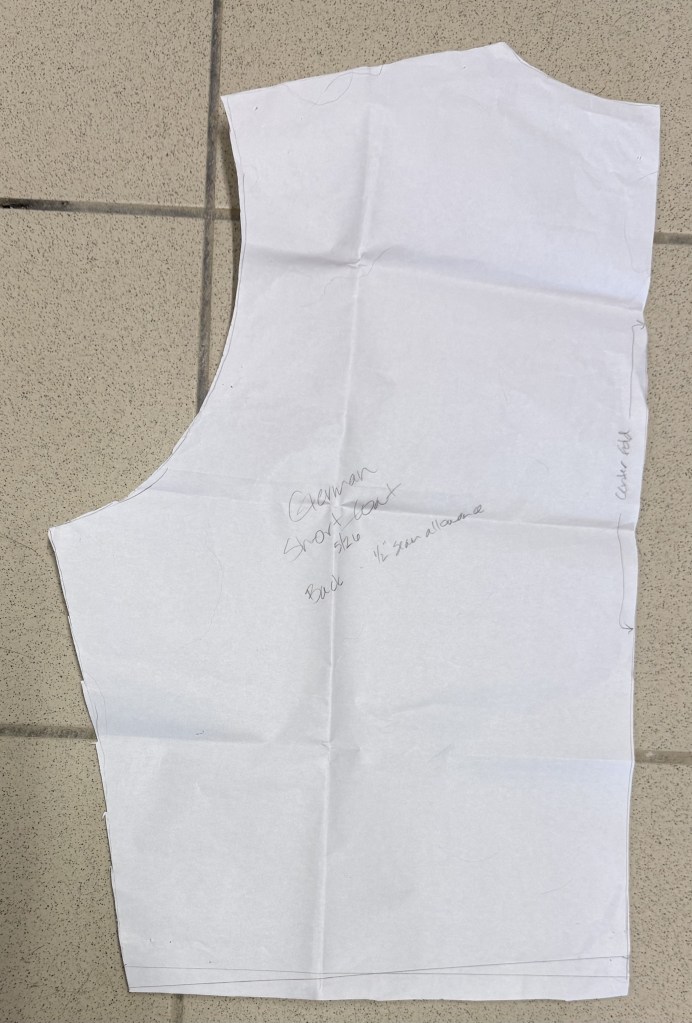
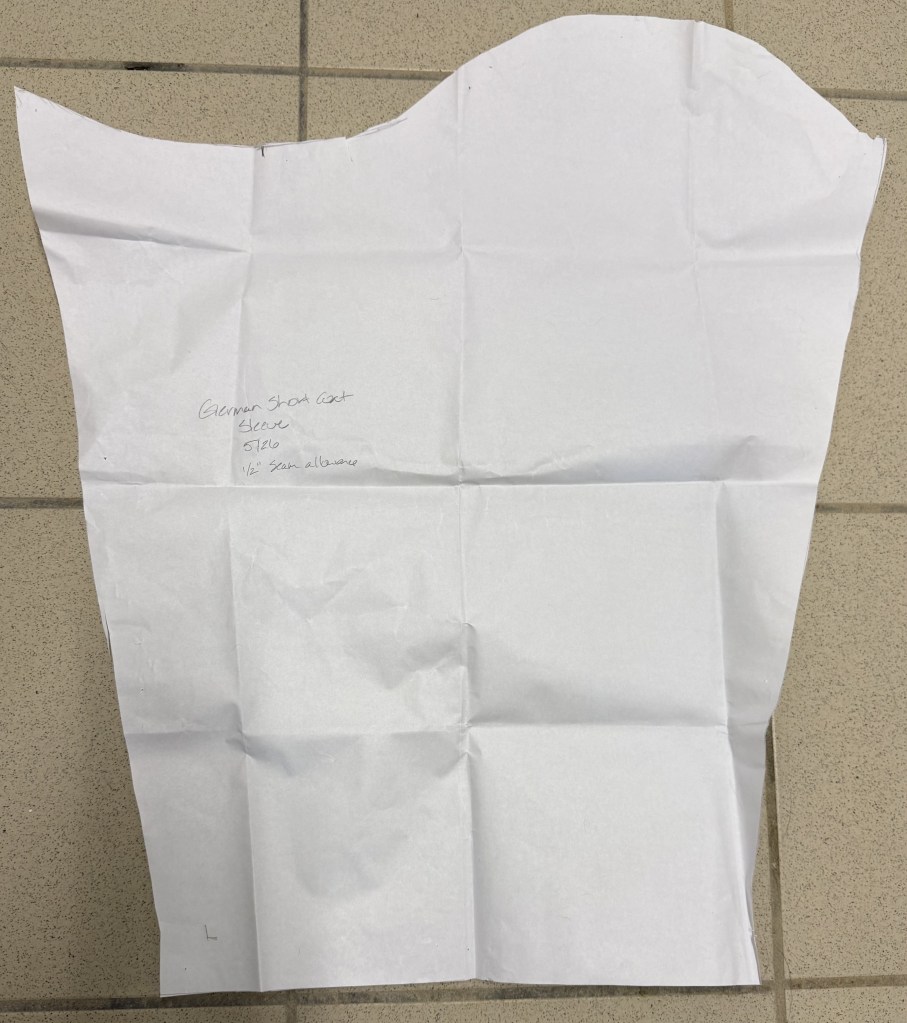
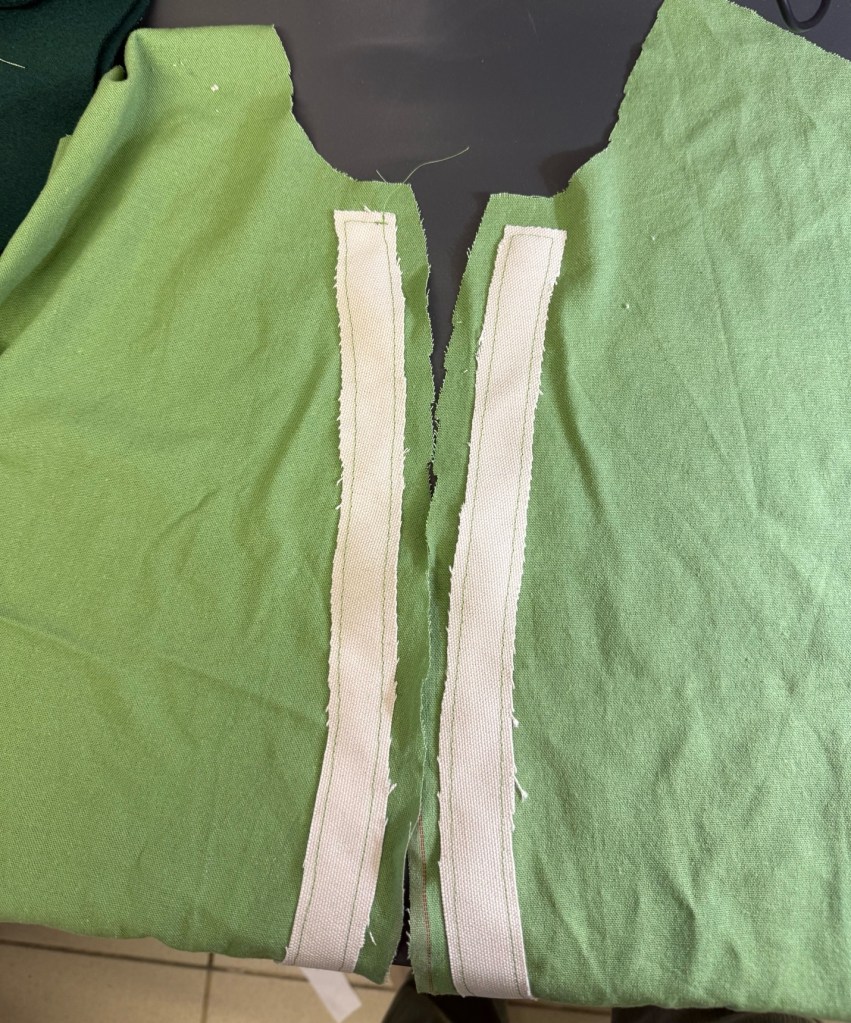
I made my prototype a little long, but trimmed it off just below my natural waist. I adjusted the center front and neckline, and proceeded to cut into my good fabric. While I chose not to interline overall, I did decide to add a stabilizing canvas strip at center front to anchor the eventual hooks and eyes.
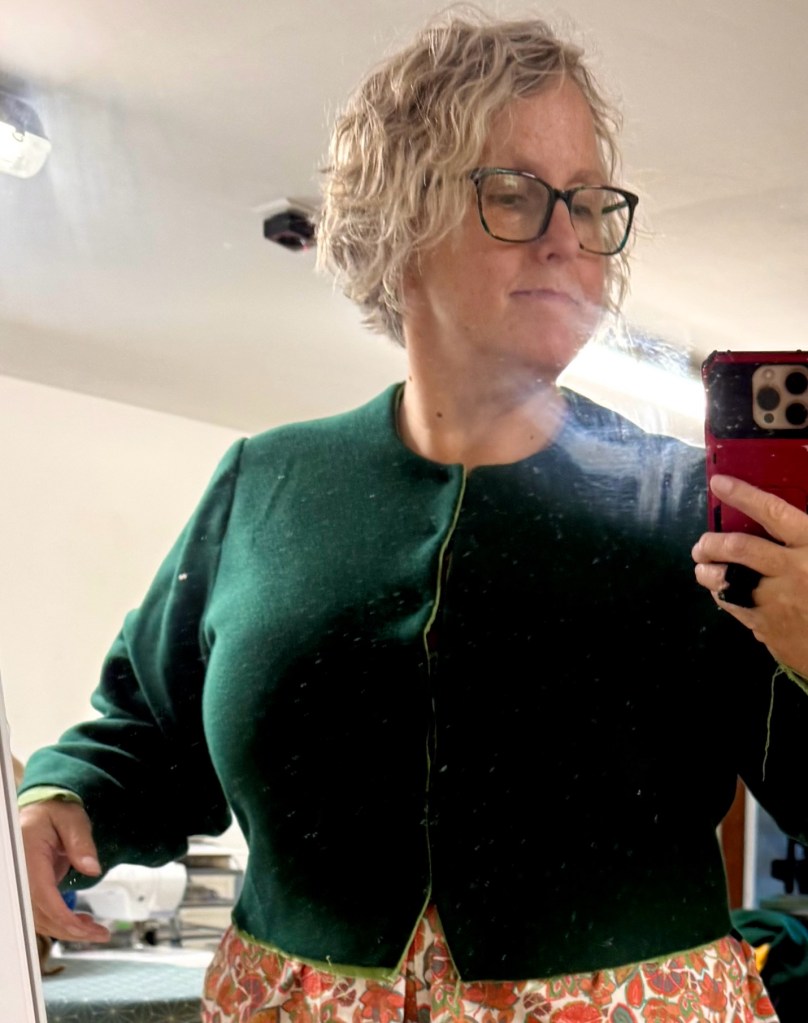
I was super happy with the fit of the bodice! I used a tape at my natural waist to mark my natural waistline, as level from front to back as possible.
I decided I wanted my skirt to be the the same length as my bodice, did some complicated waistline measurement and math, drafted that waist measurement circle on my fabric, then laid out a full circle skirt from that line using a clear quilter’s grid (one of my favorite sewing tools!). I made the back of the skirt 1” longer than the front, because the back of a skirt hanging a bit short looks derpy.
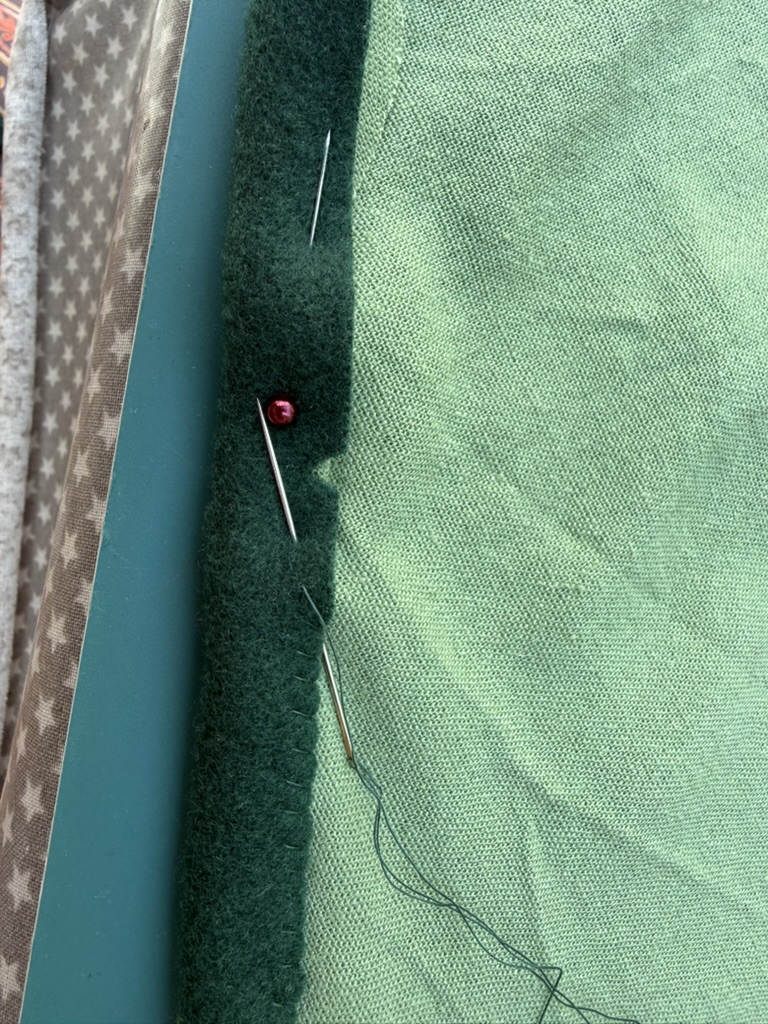
Notice that I sewed the raw front edges together, turned and pressed, and basted/stay stitched the waist edge before truing up lining and skirt fabric measurements.
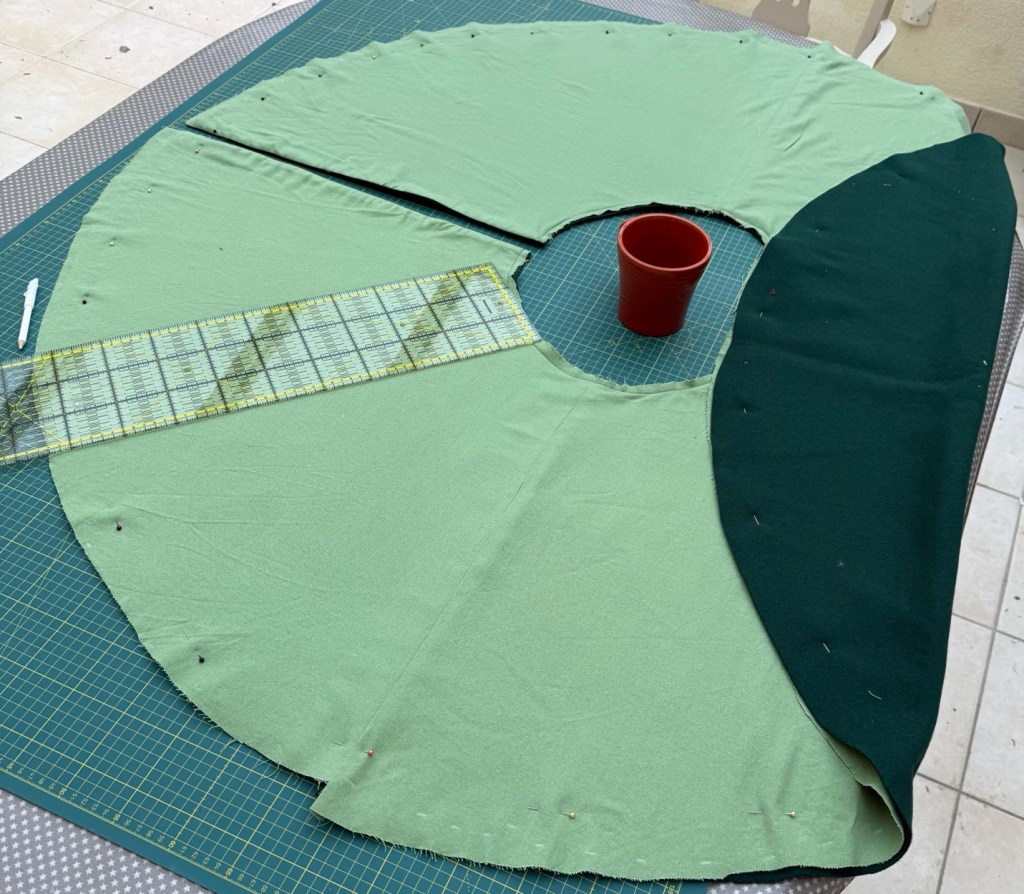
I carefully aligned the skirt edge with the bodice edge, good side to good side, and stitched the skirt in place to the wool layer. My math worked out, but had it been a little off, I could have eased the skirt to match, as most of the waist edge was on the bias.
Again, quite happy with fit and proportions, and the level of the skirt bottom is even from the front to the back. (I could have even added another inch to the back.)
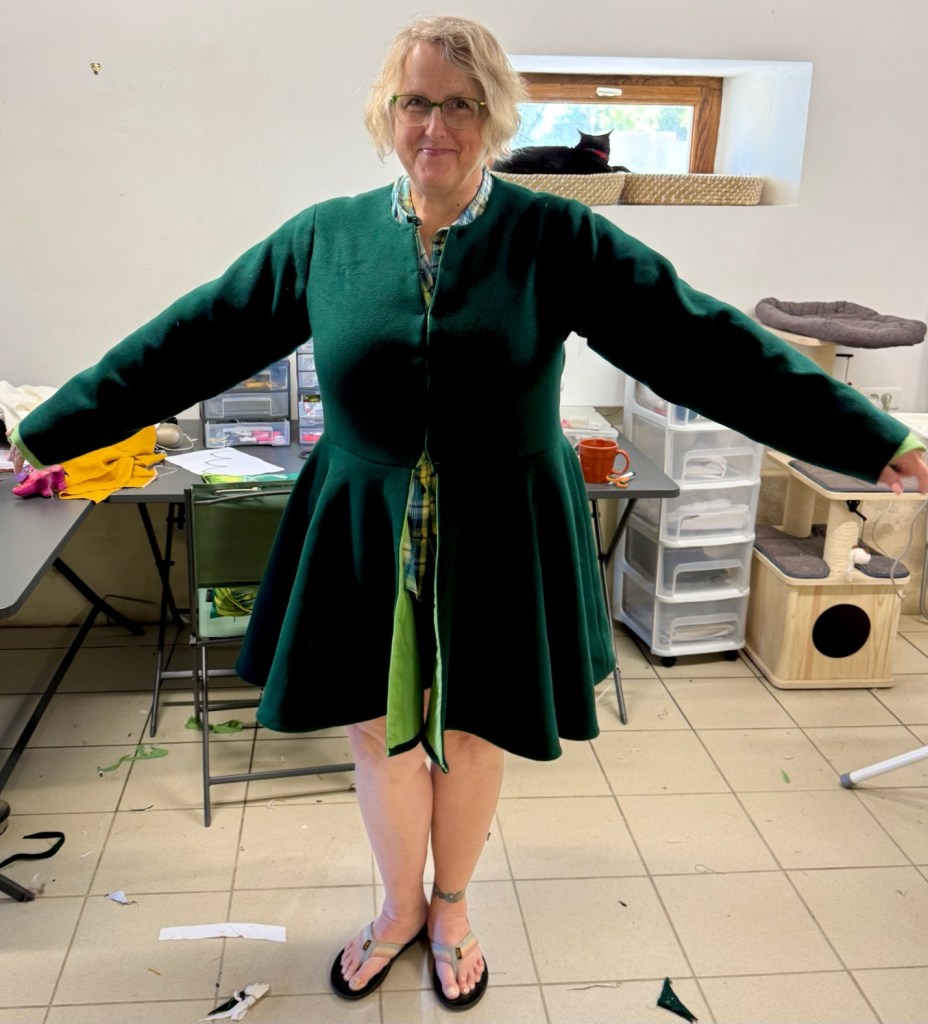
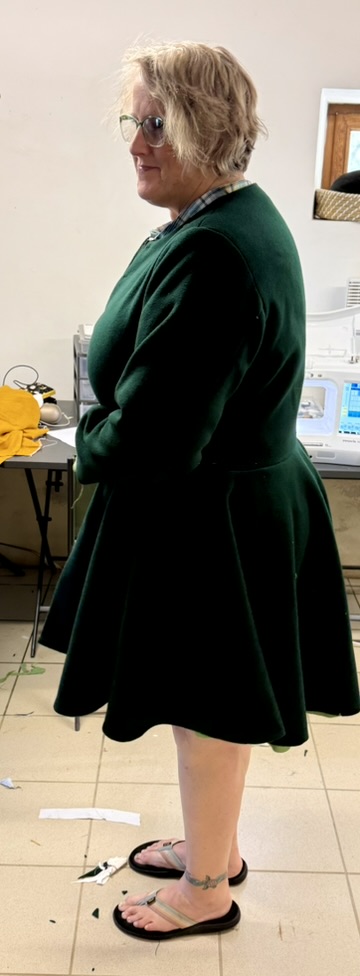
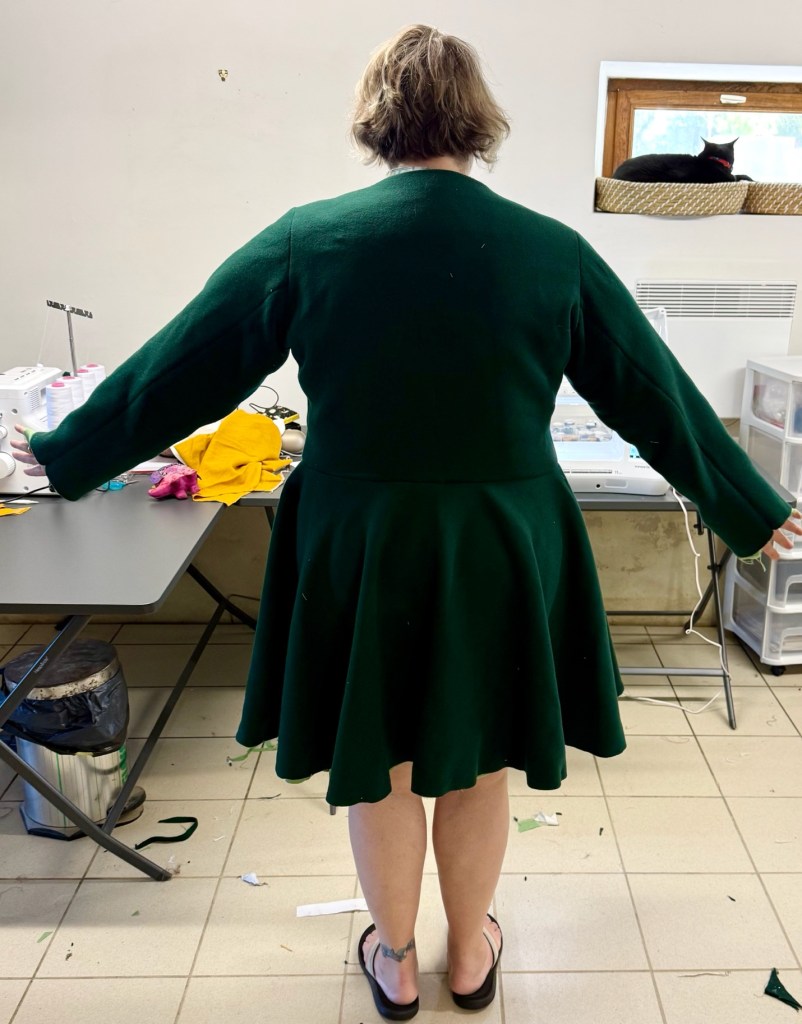
I notched the curves along the waistline and whip stitched the bodice down over the waistline. I added a couple more hooks and eyes to the center front, although not enough, and whip stitch hemmed the skirt and the cuffs. A friend suggested I could correct the hang of the front center by carefully curving the edge with a steam iron – she was right! Totally fixed it.
The Final Coat
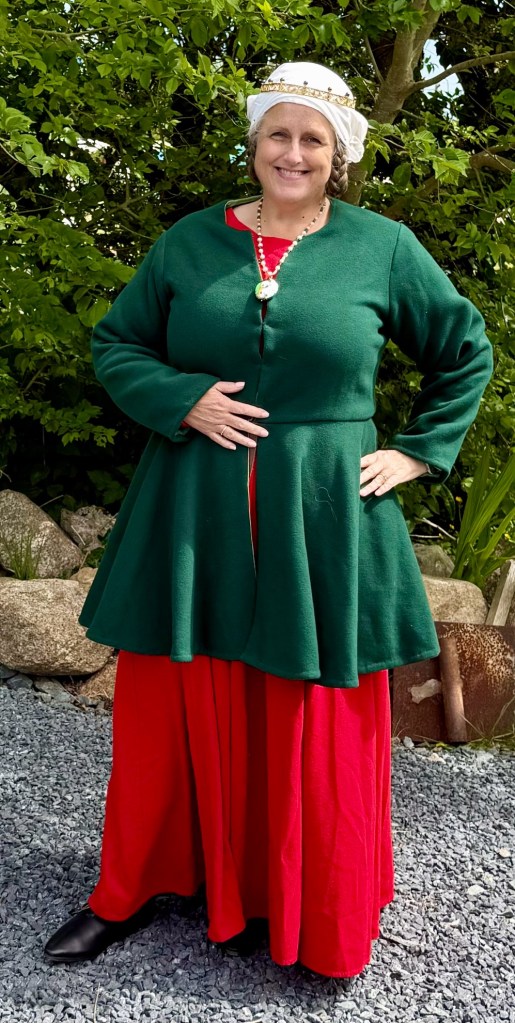
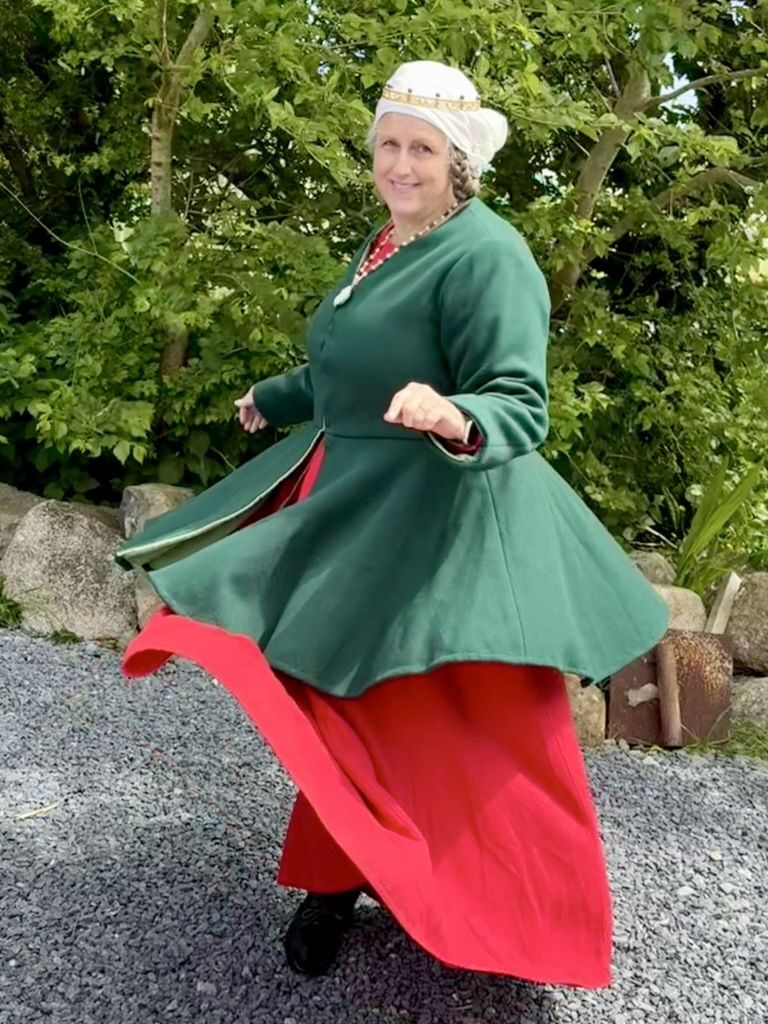
Et voila! The final coat. I really like it, it is super comfortable and it twirls beautifully.
Next Steps
As I mentioned, it needs more hooks and eyes over my bustline. More importantly, I think I may pick the center front seams out and add cording to the inside edge, to help manage strain and any gaps. One of the later period images of a leib rock clearly shows a corded front edge.
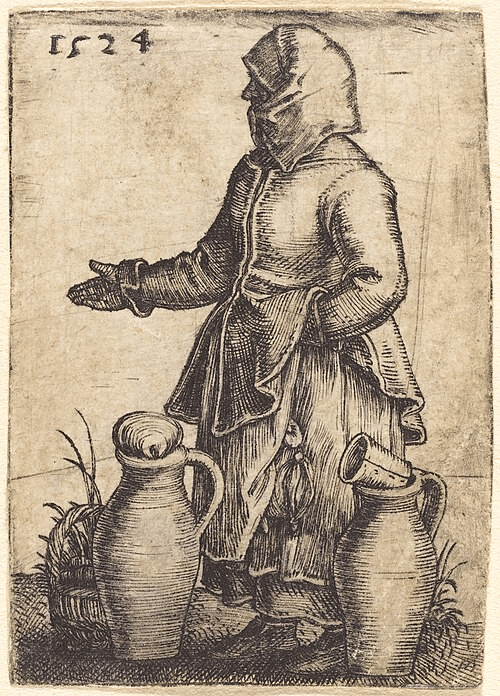
Barthel Beham, Peasant Woman with Two Jugs, 1524
On the whole, I love this coat, and envision wearing it frequently when the temperature drops even a little. (I can even wear it with modern clothes in the winter – it is pretty versatile.) This is the most excellent garment I’ve made in years.
Resources
https://handcraftedhistory.blog/2022/10/01/medieval-jacket-for-a-woman/
https://rowantreeworkshop.com.au/1530s-german-womans-jacket/2018/
Barich, K., & McNealy, M. (Eds.). (2015). Drei Schnittbücher: Three Austrian Master Tailor Books of the 16th Century. Nadel und Faden Press.
https://differentvisions.org/introduction-towards-a-visual-history-of-the-working-class/
https://historycrunch.com/social-classes-in-the-middle-ages/
https://www.habsburger.net/en/glossary/what-could-viennese-buy-their-kreuzer-and-gulden
https://new.coinsweekly.com/coins-medals-more/from-taler-to-mark-the-long-road-to-a-common-currency/

