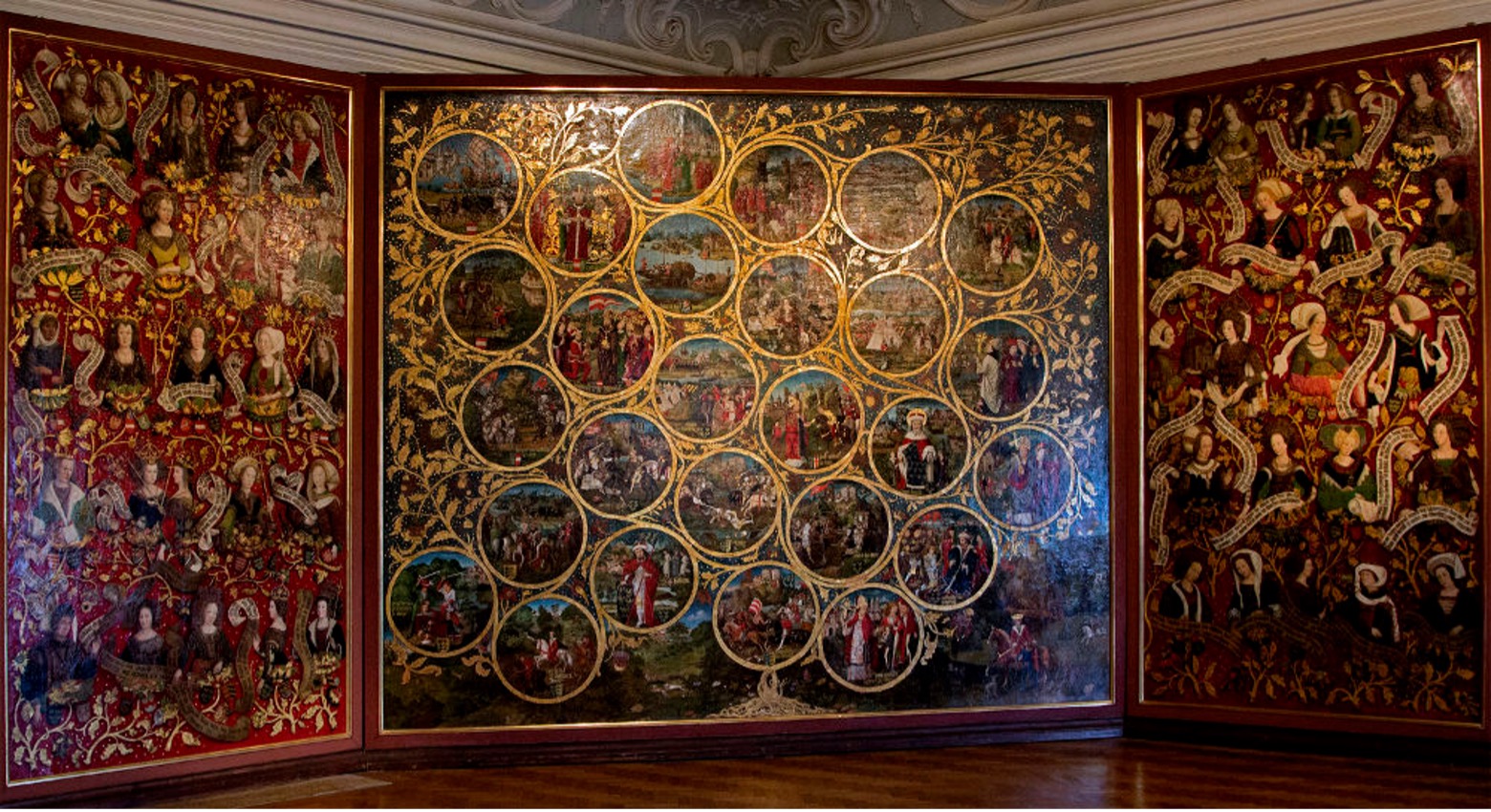
I am a bit obsessed with the Babenberger Stammbaum, so this record will turn up more than once in my research and experimental archaeology. The Babenbergs were the first ruling house of Austria, reigning from 976 to 1246 AD. The family tree, the Stammbaum, was painted more than 200 years later, 1489-1492 by Hans Part, celebrating the canonization of Saint Leopold (Leopold III) in 1486.
The entire triptych is approximate 8m wide by 4m tall, and the use of the triptych format, usually associated with altarpieces, adds a layer of importance to the subject matter. The central panel contains roundels depicting scenes from the lives of all male Babenbergs, and the lateral panels show the Babenberg rulers´ wives and daughters.
As a costumer, I am especially interested in the clothing depicted in this huge visual family tree. Each figure is depicted wearing contemporaneous but idealized, even exaggerated costumes of the 15th century. These luxurious, highly detailed garments and indicate the high status of the subjects.
One of my frustrations with historical analyses of the Stammbaum is that the emphasis is usually on the men. They were the rulers, after all! The inclusion of the wives and daughters is unusual for the time, but art historians suggest that it is political choice. These female figures show the diplomatic alliances formed through marriage, and the broad network of international connections the Babenberg family represents.
Rabbit Hole!
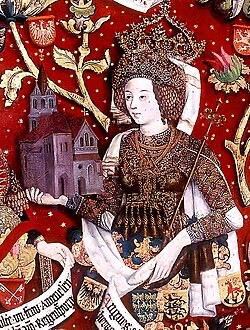
Agnes of Waiblingen, (1072-1143), above, was daughter to Emperor Henry IV. She married Duke Frederick of Austria in 1086, becoming Duchess of Swabia, and she gave birth to 5 children with him. In 1105, Frederick died, and she subsequently married Margrave Leopold the Holy (1073-1136), making her Margrave of Austria. She subsequently bore 18 children between 1105 and 1120.
According to historian Floridus Röhrig, “Among the 18 children of Margrave Leopold the Holy, seven died in early youth, including five girls. We do not know their names. These ladies are depicted as too old, as they died as children and were all buried in the Kapitelsal zu Klosterneuberg
Let’s do the math: this royal woman gave birth to at least 23 children, beginning at 14 or 15 years old, with 18 of those births between 1105 and 1120. She was 48 years old when her last child, Judith, was born, and lived to be 71. That is an impressive constitution!
By comparison, the average lifespan of a European noblewoman in the 12th century was a little over 40 years. Also, death in childbirth was very risky even for noblewomen, with a maternal mortality rate of nearly 20% during childbirth and postpartum recovery.
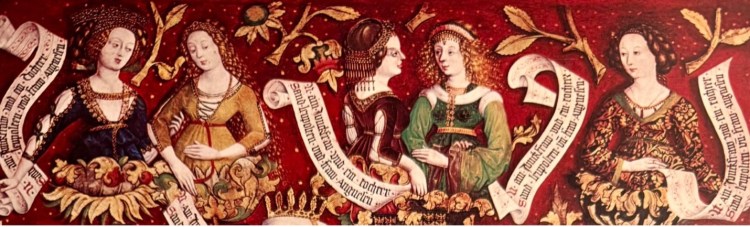
These nameless lost children make me sad. The artist of the Stammbaum chose to paint representations of the lost daughters in the top row of the right wing, depicted below.
Analysis of the Image
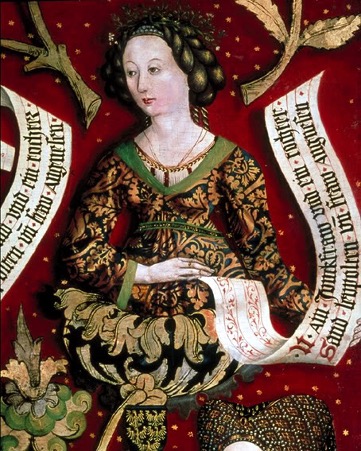
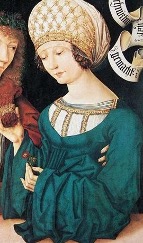
Three years ago, the specific image I chose to recreate, without having any background at the time, is a symbolic image of the last lost daughter. Had she lived, she would likely have been married to a prince or duke from another central European country and gone on to found her own dynasty of royal sons and daughters.
This lovely, nameless daughter was painted wearing a stehfaltenkleid, or housebook dress, made with standing pleats, and of green and gold damask. Her collar and cuffs are apple green, and the painting gives no real clue to the fabric, but the collar and cuffs are not shiny – so, velvet or wool? Her hemd is pleated, likely of white linen, with gold cord and black and white braid around the neckline, and gold trim in vertical strips.
Her hair is covered with huge zopfe, false braids, wrapped around each side of her head. She has some sort of filet underneath the zopfe, likely providing a surface to pin the braids to. There are at least three wide cords draped from the back of her head – possibly ties for the zopfe? They are too wide and broadly spaced to be a gefrens (fringe). She also wears a delicate coronet, which is difficult to see in this image.
Her belt looks to be of a dark green cloth, with brighter green corded edges, and possibly some gold belt mount hardware. The buckle of her belt is not visible and likely turned to the back. She’s wearing two cords or laces around her neck, possibly holding a pendant cross or pomander tucked into the bodice of her dress. She might be wearing a small ring on her middle finger; it is difficult to verify from the images I’ve found.
Fabric
I don’t often make anything shiny/silky/brocaded for SCA wear. I was going to say never make – but then I recalled a green and gold German Renaissance dress I made very early in my SCA days. It’s lovely, and fit well, but it was made of inexpensive poly brocade, trimmed with poly velvet, interlined with poly outdoor canvas, and lined with super slippery poly satin. It was wildly uncomfortable, like wearing a personal sauna that also slid off my shoulders every time I exhaled.
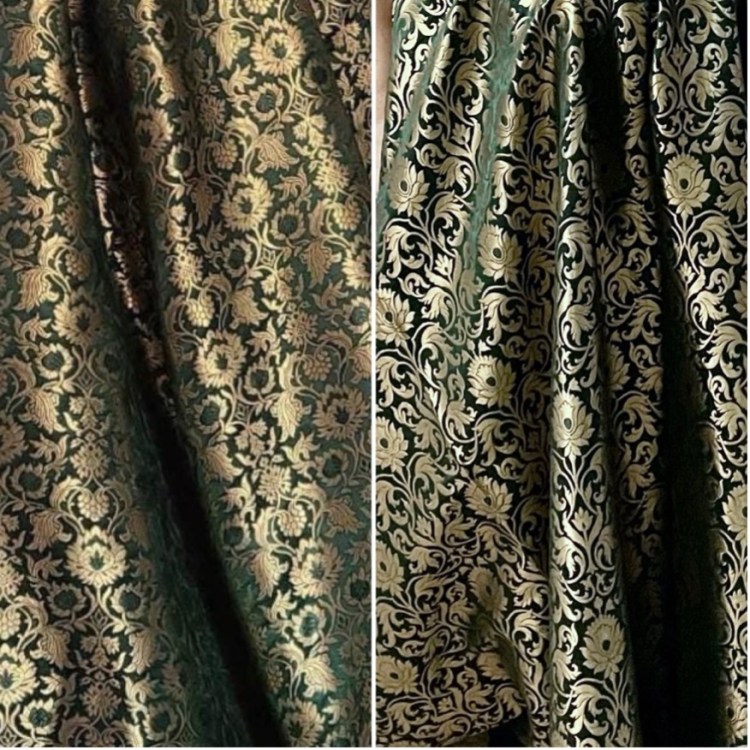
The dress from the Babenberger Stammbaum called for a green and gold damask or brocade, so I went shopping. I made a pilgrimage to Sandhu Fabrics and Arora Fabrics, cloth houses in Surrey, BC, Canada, and found a really lovely brocade, below right, that had the right look and drape for this project.
The fabric on the left is glorious – it’s Sartor historical reproduction silk brocade. But the fabric on the right is $12.99/m poly silk brocade – and it is not hugely different in value and overall look. (A historical textiles expert would be able to tell that the cloth house fabric is not based on a medieval pattern.) I chose it anyway, as the visual impact works well for this project. I’ve found that while poly silk is not my favorite, it’s wearable when lined with linen, and if used in a garment that has a loose drape, it can be comfortable.
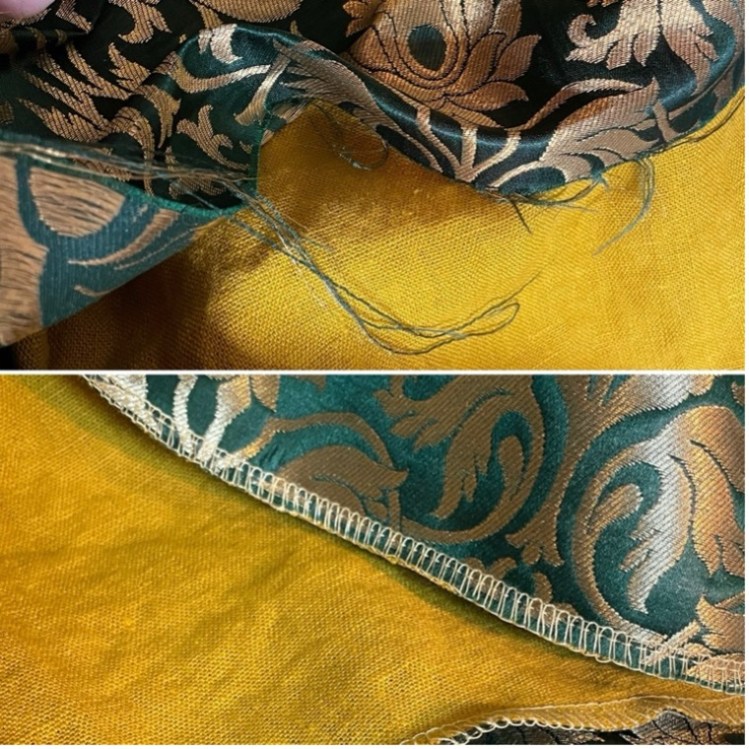
Whether silk or poly, brocade is challenging to work with, and has lots of long flossy threads that unravel and shed. I flat-line everything so the fabric doesn’t drive me up the wall! I’m privileged to have a serger, but a zigzag stitch or a whip stitch would work as well.
Construction Process
The dress depicted is a stehfaltenkleid, or housebook dress – a dress unique to Germany and Bavaria toward the end of the 15th century. I wanted to try achieving this look without an inset panel of pleats, but instead creating soft pleats that could be belted into place. (This goal will come back to bite me, later.)
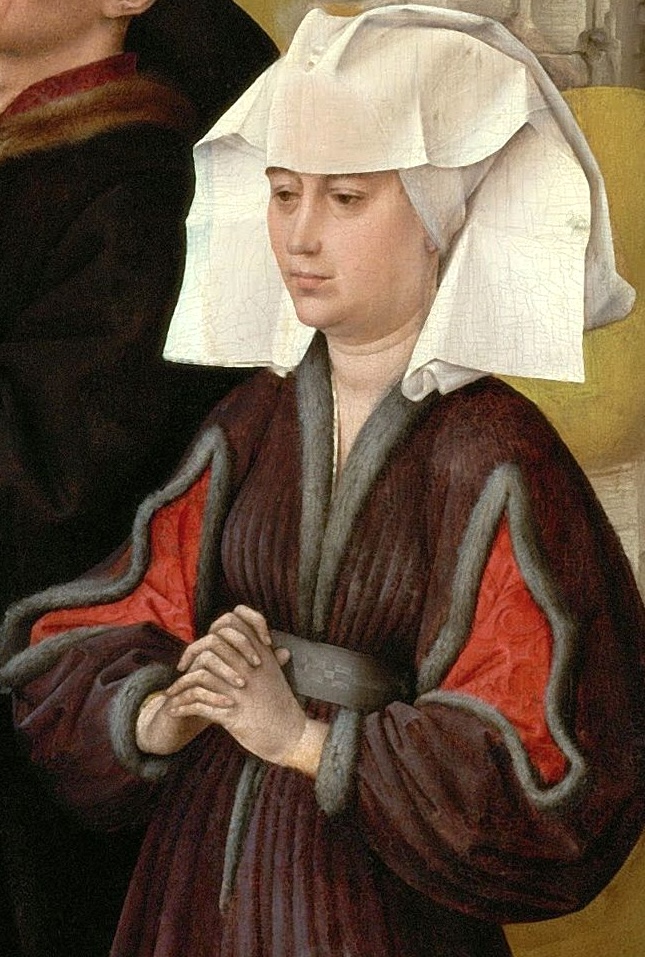
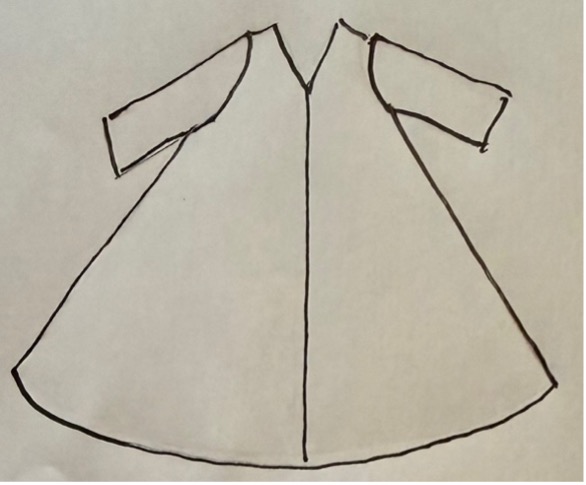
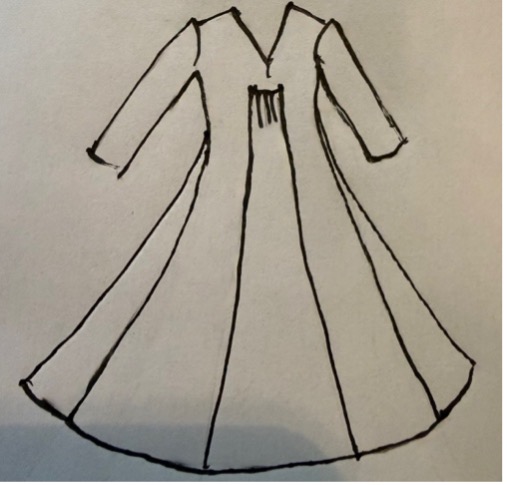
One of my theories of the evolution of German garb is that the houppelande evolved into the housebook dress. The houppelande on the left has a voluminous cut and generous pleating and was painted by van der Weyden in 1445. The housebook dress on the right has a trim fit and vestigial pleating and was painted by the Master of the Housebook in 1484.
More importantly, the below sketches indicate how these two dresses are constructed. The houppelande, on the left, is a half circle or a full circle gown, cut loose and voluminous, with a belt above the natural waist. The housebook dress, on the right, is fitted and gored, with a belt optional, but at the natural waist if used.
As with all costuming projects, I started by drafting a pattern and making a mockup. Since this is a loose, belted dress, the mockup worked just fine on the first draft, so I moved onto laying out and cutting out the garment.
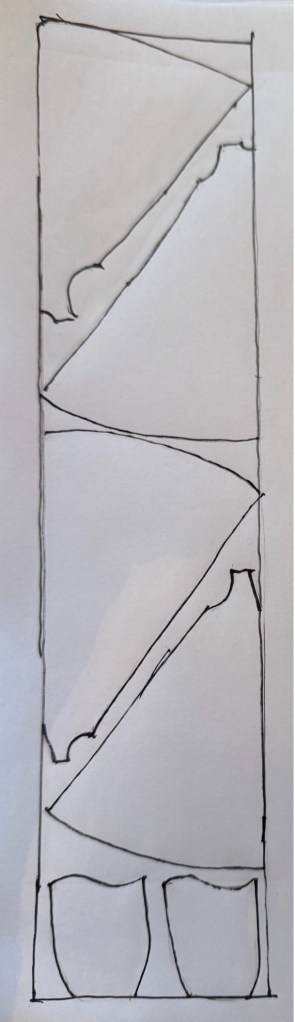
Rather than cutting out a gored garment, I cut out a houppelande type garment, minimizing gores by cutting the full width of the 45” fabric. (Mistake #1) I also placed the center front and center back on the straight grain of the fabric. (Mistake #2) Fabric cut on the bias will drape and fall into soft pleats much more easily; fabric cut on the straight grain tends to hold its shape.
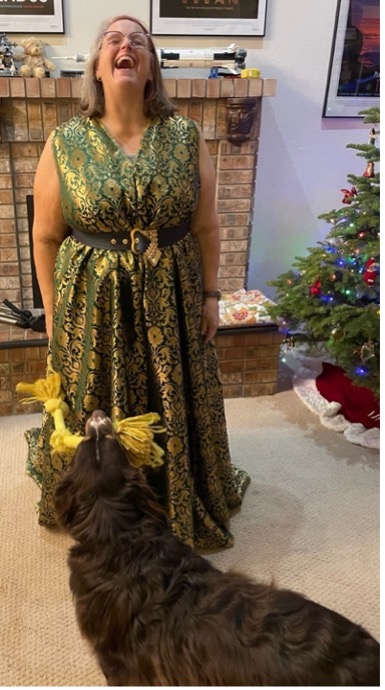
This try-on is my check for the drape and movement of the fabric and the construction. My tailor’s assistant did a great job of distracting me! I didn’t really notice that the soft pleats were going to be a problem, at this point – although I did notice that the neck opening was not deep enough, and fixed that.
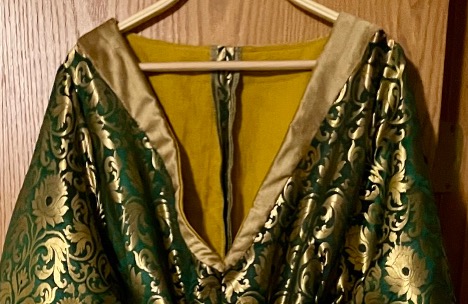
I started with a mockup of the collar in muslin, and when I was happy with the lay of the fabric, I cut collar and cuffs out velvet. I did not use apple green velvet, as I had gold panne velvet in my stash, which is a type of silk or rayon velvet that was not seen until the 1800s. It is created by applying heavy pressure to flatten the fabric pile in a single direction, creating shine that follows the drape of the fabric. Panne is not obtrusively modern, so I used it, lined the collar and cuffs with linen, then whip-stitched them into place.
Note from this photo that I used very modern construction – machine seams, serged edges, and even machine top stitching the neckline flat as it would be covered by the collar. For garments not being shown for A&S purposes, I absolutely use machine sewing as much as possible. It’s comfortable and durable, and I save my limited hand work capacity for edge finishing where it will be seen (the inner and outer collar edge).
I have a fatal attraction to trains on court dresses, and I chose to add a 12” train to this dress. That is not reflected in the above pattern layout sketch.
The Final Dress
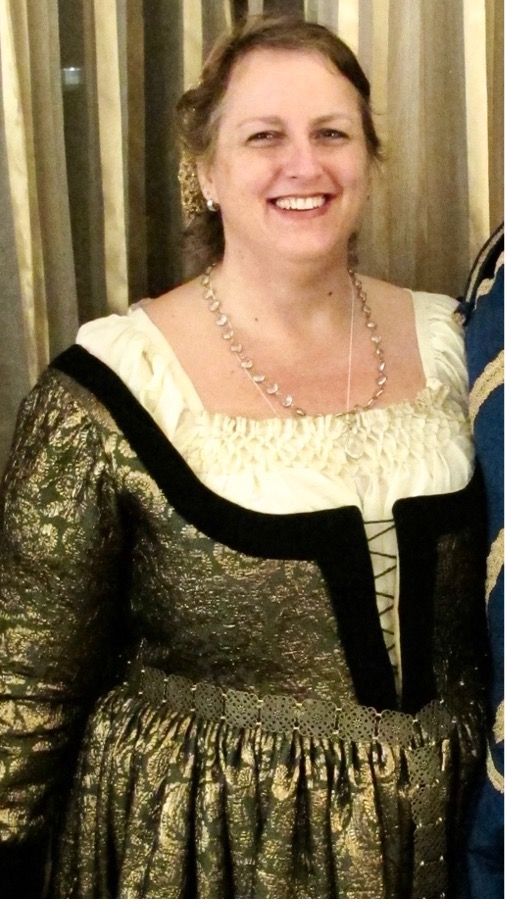
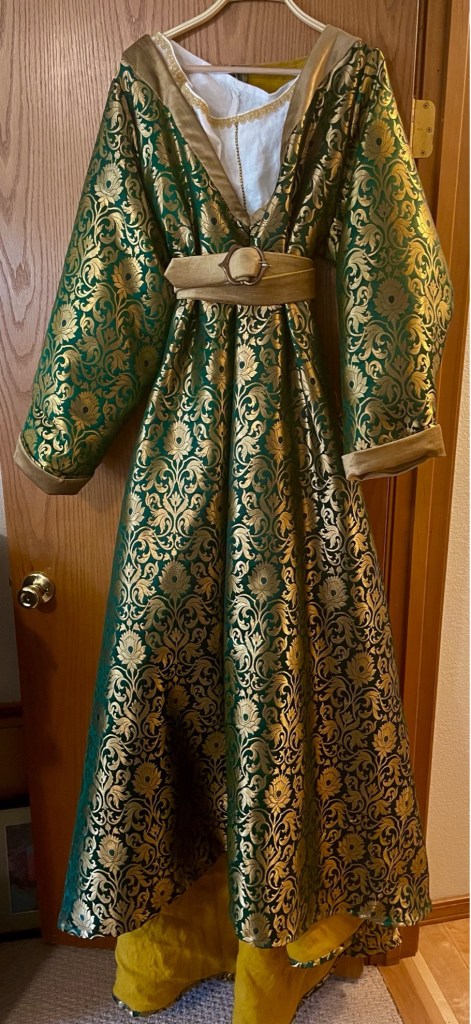
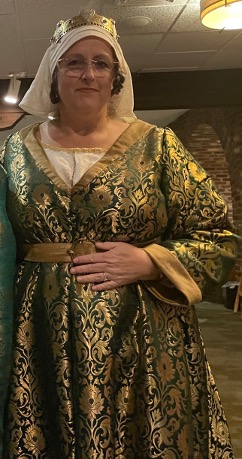
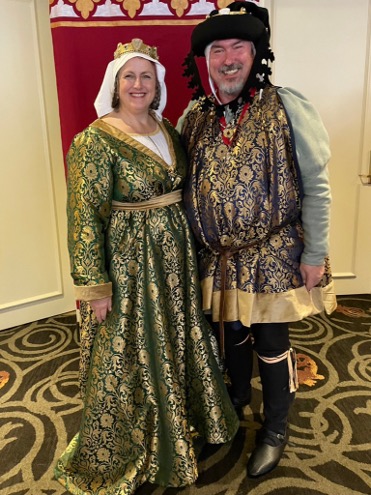
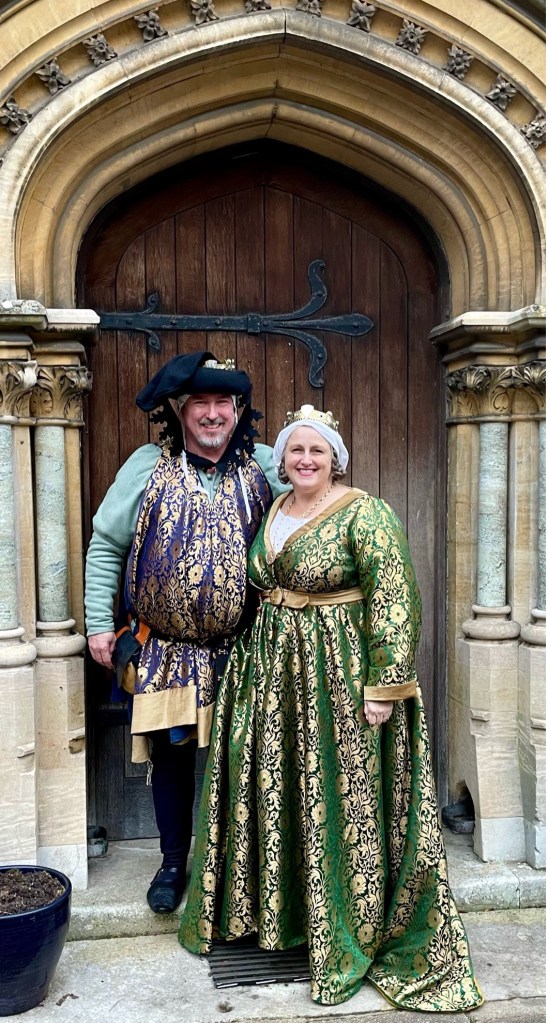
Upon wearing, I realized two things: first, this is a super sturdy, comfortable, easy-care dress, and second: it was not going to pleat softly at center front and back, housebook dress style.
I’d made a very pretty, shiny houppelande instead, and when I pleated it evenly around the waist, it draped beautifully.
Next Steps
Next step is to re-visit making a dress from the Babenberger Stammbaum. This time I’ll select a dress from a surviving woman of the Babenberg dynasty, as wearing a dress from one of the lost daughters feels a little strange, even if the passage of time over centuries makes them all lost daughters now. I also will plan to do a couple more steps of prototyping to get the construction correct.
I also want to make an embroidered hemd, and experiment with wearing a giant zopfe headdress, at a scale similar to some of the Babenberg ladies.
The ultimate step in research, now that I live in Europe, is to plan a quest to visit the Babenberger Stammbaum in person, possibly with a guide who has expertise on this piece of art. This is in progress for, perhaps, this fall.