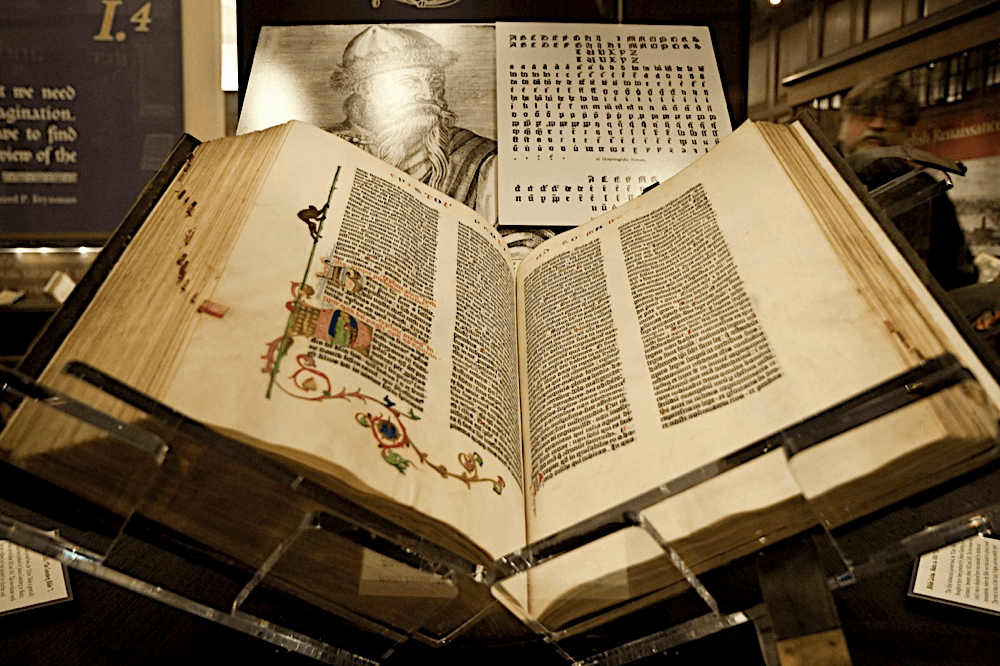
“[The printing press] is God’s highest and extremest form of grace, whereby the business of the gospel is driven forward.” ~Martin Luther
In 1448, Johannes Gutenberg invented the movable type printing press, accelerating change and growth throughout Europe. Literacy and knowledge had been formerly the province of the church and priesthood, but the advent of the readily available, vernacular printed word made learning and letters accessible to individuals at all strata of society.
In 1517, reformation scholar Martin Luther nailed his 95 Theses to the door of the church in Wittenburg, Germany. Instead of the academic debate he expected, his writing ignited Catholic controversialism and the rise of the Protestant reformation in Europe.
These two sweeping changes are related. The creation of the movable-type printing press facilitated the rapid spread of the Protestant reformation. At the same time, reformation literature became a huge percentage of early printed works, driving growth of both the printing industry and common literacy.
The Printing Press
Contrary to popular belief, Johannes Gutenberg did not invent the first movable type printing press. That honor belongs to 11th century Chinese printer Bi Sheng.[1] Nonetheless, it was Gutenberg’s press that ignited the printing industry in Northern Europe.
Prior to the the invention of the movable type printing press, the majority of books were either copied by hand or block-printed. The latter required that each page of a text be carved into a block of wood, inked and pressed onto paper.
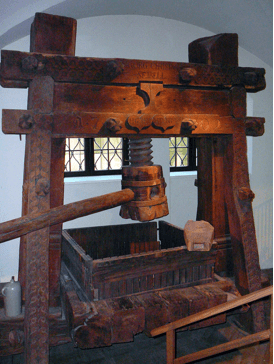
Gutenberg’s movable type press was based on the existing screw press used in winemaking and papermaking. He refined the screw press to apply even pressure across the print area, and adapted it to easily handle inserting and changing sheets of paper. [2]
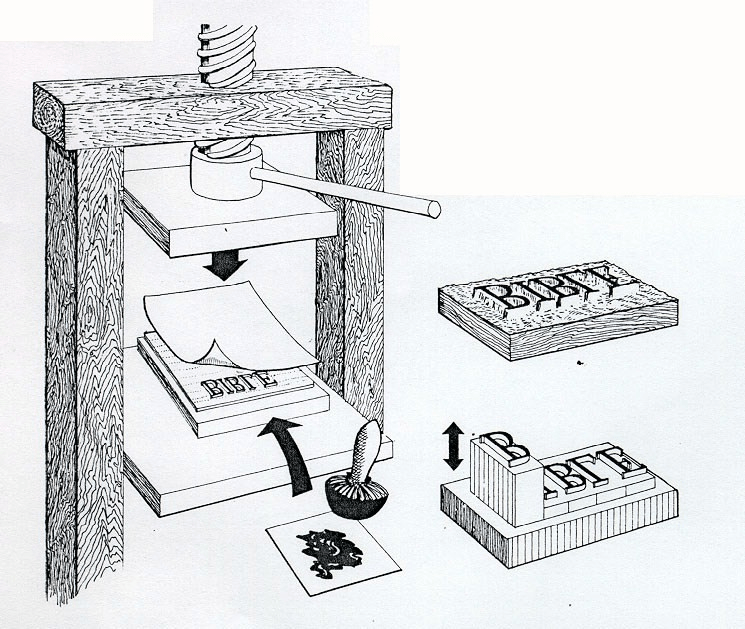
A critical component of his invention was a method for handcasting movable type, allowing the printer to quickly cast the required number of a diverse range of characters.[3]
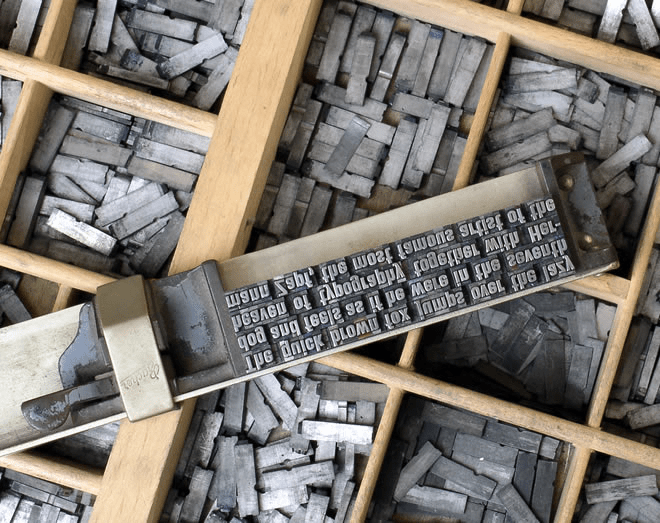
Movable type printing dramatically accelerated the production of printed materials, making printed broadsides and books available to the general public. Each page of print was called the “masterforme”, and during the early 16th century, production could reach 1250 sheets printed per day from a single masterforme.[4] Prior to the advent of mass-production printing, this production took place via laborious hand-scribing or hand-rubbed prints from a woodblock.
At that time, only the Catholic church and the elite were able to afford books and thus only a small percentage of the population knew how to read and write. It is estimated that by 1500, the explosion of the print industry accounted for fifteen to twenty million copies of 30,000 to 35,000 separate publications in circulation. [5] Books printed before 1500 are referred to as incunabula, referring to the infancy of printing.
The printing press helped drive the standardization of spelling, grammar and typography, and the resulting uniformity and reliability of the written work made books more readable by the common man.[6] In the decades following the invention of the printing press, the growth of printing industry advanced mass literacy as demonstrated through a drastic rise in adult literacy throughout Europe. [7]
The Protestant Reformation
The Protestant Reformation in Northern Europe dated from 1517, when noted theologian Martin Luther nailed his 95 theses to the door of the church in Wittenberg. As a note, nailing them to the door of the church was not a form of vandalism or rebellion. It was the bulletin board of its time. [8]
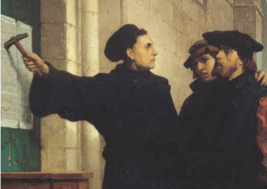
There had been previous attempts at reformation – in 1376 by John Wycliffe, and in 1414 by John Hus [9] — but the Lutheran reformation occurred at the right time and place to ignite change throughout Europe.
Timeline of The Reformation[10]
| 1517 | Luther posts his 95 theses |
| 1521 | Luther is excommunicated at the Diet of Worms |
| 1522 | Luther translates and publishes a German version of the New Testament |
| 1524 | Augsburg outlaws many Catholic practices and holidays |
| 1526 | Tyndale publishes the first English translation of the Bible |
| 1530 | Luther presents the Augsburg Confession to Emperor Charles V |
| 1534 | Church of England separates from the Roman Catholic Church |
| 1540 | Martin Luther dies in Eisleben, Germany |
| 1555 | The Peace of Augsburg extends tolerance to Lutherans within Holy Roman Empire |
The religious basis for the Reformation? The Catholic Church had, over the years, become deeply involved in the political life of western Europe. One obvious abuse was the sale of indulgences (or spiritual privileges) by the clergy. Luther’s 95 Theses challenged this practice. He claimed that what distinguished him from previous reformers was that while they opposed corruption in the life of the church, he attacked to the theological root of the problem—the perversion of the church’s doctrine of redemption and grace.[11]
One key tenet of Protestantism is that the scripture and other knowledge should be available to the common man. The Catholic church objected, arguing that “You should not be your own masters” and discouraging domestic bible-reading. The message was that it was the place of the church to rule and interpret man’s worship of God.
Luther led the drive to make the Bible accessible. Until the advent of the printing press, the Bible was transcribed in Latin, the language of the Church, and copies of the Bible resided primarily in churches and monasteries. [12] In 1522, Luther translated and printed the first German copy of the New Testament, and in 1526, William Tyndale published the first English copy of the Bible.
One question is whether the low literacy rates of the time invalidate the proposition that vernacular translations of the Bible created accessibility among the common people. In Germany, rural literacy is estimated at perhaps 5%, and urban literacy could possibly have reached 30%. It seemed, however, that combining the new sacred texts with the existing oral tradition gave them power and reach. In many towns, Luther’s works were read aloud in the marketplace, and many households read the same sacred texts aloud at dinner or to guests assembled in their home. It is thought that the availability of sacred texts in the vernacular motivated some of the populace to learn to read.[13]
Impact of Printing Press on the Reformation
Between 1448 and 1520, the print industry exploded throughout Europe, with Germany at its center. In 1520, there were fifty identifiable printers in twelve locations producing Luther’s works, and another seventy printers producing other Reformation literature. These included the Bible, other religious books, and various pamphlets and broadsides. The odds are that any given German printer produced Reformation pamphlets and broadsides. The eventual war of literature between Protestants and the Catholic church was a lopsided one, with Luther at a significant advantage.[14]
The Catholic church seemed to not comprehend the potential of print as a medium, and throughout the 1520s Protestant output significantly outnumbered that of the Catholic church. In addition, Martin Luther rapidly became a popular author whose appeal was not matched by any of the leaders in the Catholic church.[15]
These generalizations are substantiated by a detailed study of publications in Germany from 1521-1545, conducted and published by Dr. Richard Crofts.[16]
| Non-Religious Works | Works by Reformers | Works by Catholics | Total Works | |
| 1521-1525 | 291 = 15% | 890 = 46% | 328 = 16.9% | 1936 |
| 1526-1530 | 352 = 33.1% | 268 = 25.2% | 247 = 23.2% | 1063 |
| 1531-1535 | 425 = 46.0% | 209 = 22.6% | 168 = 18.1% | 924 |
| 1536-1540 | 450 = 50.4% | 169 = 18.9% | 135 = 15.1% | 892 |
| 1541-1545 | 411 = 49.1% | 171 = 20.4% | 115 = 13.8% | 836 |
| TOTAL | 1929 = 34.1% | 1707 = 30.2% | 992 = 17.6% | 5651 |
In every year documented by the study, Protestants significantly outpublished the Catholic church, especially during the seminal period from 1521-1525. It’s also significant to note that, in addition to the 30.2% overall Reformation share of the printing marketplace, 20.2% of the Catholic publications from 1521-1530 are identified as controversialist. (Controversialist meaning works directly opposing or refuting Reformation theology.) This data indicates that the Reformation was a large part of the continued explosion of the print industry in Germany (and Europe overall).[17]
Also of interest, in the period 1521-1525, Luther himself accounted for 60% of the Reformation books published. Of that total, 89% were published in the vernacular German.[18] This illustrates how popular the man’s works were, and defines him as the print mogul of his time.
Conclusion
The opening quote illustrates the importance Martin Luther placed upon the printing industry.
“[The printing press] is God’s highest and extremest form of grace, whereby the business of the gospel is driven forward.” ~Martin Luther
While, as a layperson, I cannot speak to divine providence, I do believe the data most certainly substantiates that it drove the business of the gospel – the Protestant gospel – forward.
[1] D.S. Yates, “China’s Age of Invention,” Nova, http://www.pbs.org/wgbh/nova/ancient/song-dynasty.html. Copyright February 2000.
[2] “Inventor of the Week: Johann Gutenberg,” Lemelson-MIT, http://web.mit.edu/invent/iow/gutenberg.html. Copyright 2014, MIT.
[3] John Burland, “Gutenberg’s Invention”, Gutenberg’s Invention, http://www.gutenberg.de/english/erfindun.htm.
[4] Richard A. Crofts, “Printing, Reform, & the Catholic Reformation in Germany, 1521-45”, Sixteenth Century Journal 16:3 (Fall 1985).
[5] McLuhan, Marshall, The Gutenberg Galaxy: the Making of Typographic Man. University of Toronto Press, 1962.
[6] Dr. Peter Arthur, “The Impact of the Printing Press,” University of British Columbia, http://courses.educ.ubc.ca/etec540/Sept04/arthurp/researchtopic/index.htm. Copyright 2004.
[7] McLuhan, 1962.
[8] Dr. Barry Waugh, “The importance of the Printing Press for the Protestant Reformation,” Reformation 21, http://www.reformation21.org/articles/the-importance-of-the-printing-press-for-the-protestant-reformation-part-two.php. October 2013.
[9] “The Reformation before the Reformation,” Quartz Hill School of Theology, http://www.theology.edu/h371.htm.
[10] Iain Emberson,“Timeline of Reformation History: 1517 – 1685,” Christianity In View, http://christianityinview.com/protestant/timeline.html. 3/20/13.
[11] “Reformation,”, Encyclopedia Britannica, http://www.britannica.com/EBchecked/topic/495422/Reformation. Copyright 2014.
[12] Elizabeth Eisenstein, The Printing Press as an Agent of Change. Cambridge University Press, copyright 1979.
[13] Waugh, October 2013.
[14] R.G. Cole, “Reformation Printers: Unsung Heroes,” Sixteenth Century Journal 15 (Fall 1984).
[15] Crofts, Fall 1985.
[16] Ibid, Fall 1985.
[17] Ibid, Fall 1985.
[18] Ibid, Fall, 1985.

