
Shipping items internationally as part of a move is logistically challenging and expensive.
Many, many experts recommend you just NOT. Show up with your suitcases, move in to a (hopefully) furnished place, and figure it out as you go. When expats list regrets about their move overseas, many say they shipped too much stuff, and the wrong stuff as well.
Others feel it’s important to surround themselves with important items that make their overseas place feel like home, and they carefully curate what they decide to ship. Either way, it’s an expensive and personal decision.
Our Process
Our shipping choices and curation process were guided by two criteria:
- We wanted to take items that had high intrinsic or sentimental value, or that couldn’t be readily replaced, so that our new home would have some precious items in it that made it feel like our home.
- We were ever conscious of the $27 per cubic foot cost number (see below details on options), and carefully thought through whether an item could be replaced for less than the shipping cost, or was worth the cost of shipping at all.
We really had no idea what our shipping volume might be. Our time frame to go through our house and destash, organize, and prepare for shipping was tight; we were limited to two months before we needed to be out of the house so it could be listed and shown. My strategy was to select what we wanted to keep and ship first, and start sequestering and packing it. Then we cleared out the rest with a combination of private sale/gift to our community, and an estate service to clear out and disseminate the rest via consignment, donation, and a trip to the dump.
I had the gift of so much help with the emotionally challenging part from many dear friends. They all know I have big anxiety issues around home organization and decluttering, and understood all too well that there were many grief triggers hiding among all the stuff. If I missed you, apologies – but thanks to Michelle, Stacey, Nicolin, Amy, Lisa, Simon, Nicole, Whitney, Arthur, Susan, Alisoun, John, and of course Kit for all the heavy lifting, high reaching, and emotional grounding.
I also highly recommend this book: https://www.amazon.com/Making-Space-Clutter-Free-Decluttering/dp/1492675199 It helped me work through a lot of family history possessions as well as unrealistic, aspirational items (projects in time-out, anyone?).
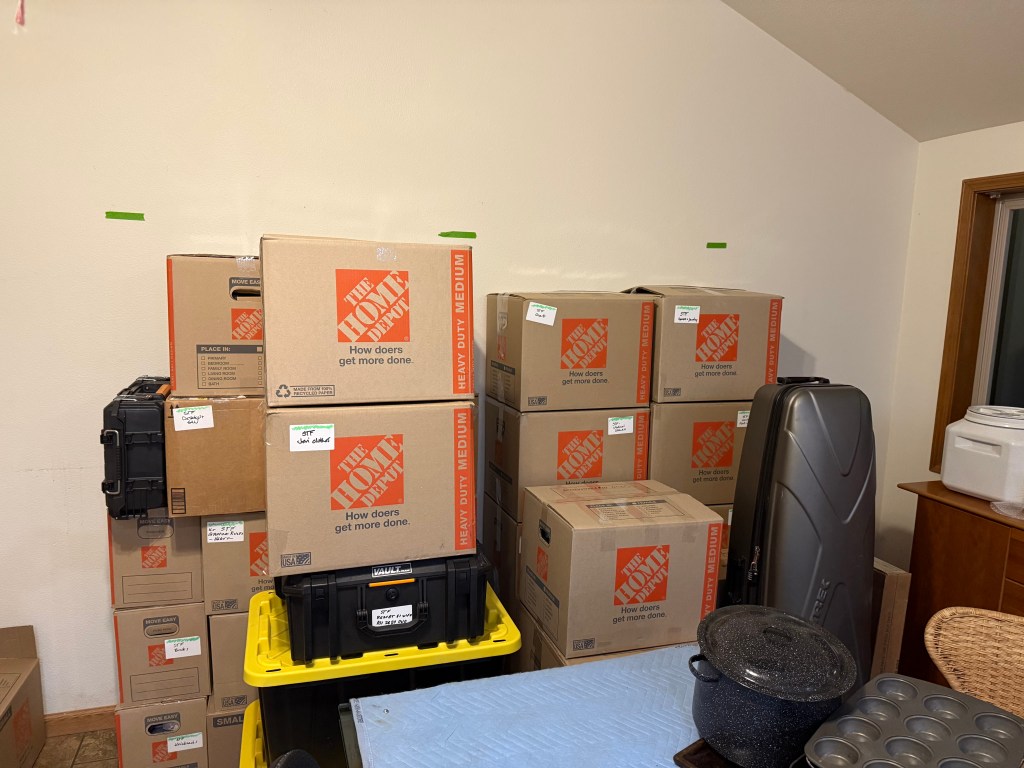
I’ve mentioned before the “stuff” challenge of being a medieval re-enactor. We both have a completely separate wardrobe, accessories, household and eventing supplies and equipment, hobby gear, etc. Medieval clothing is quite heavy and bulky – we can pack about two outfits to a medium box or a large suitcase. It truly is much like managing the personal possessions of an additional two roommates, and all of the gear is custom made and none easily replaceable.
What we Packed
We ended up with a few main categories of items we chose to take:
- Personal clothes and accessories
- Medieval re-enactment garb and accessories
- Sentimental décor items, memorabilia, and family photos
- Personally important art (and scrolls!)
- Fancy Pfaff sewing machine with a switch for Euro power, plus a few accessories and a few favorite pieces of expensive wool.
- Metalsmithing and jewelry making tools and limited supplies
- Fine art supplies and tools
- Fencing gear (as in sporting equipment)
- Astrophotography equipment and accessories
- Tactical war games and accessories (plus some standard board games as well)
- Gaming computer, accessories, and SAN
- Books (we reduced it to 8 boxes – I’d estimate we started at around 40 boxes worth)
- A splurge item – my multi-colored Fiesta Ware dishes and cups
We managed to make all 45 boxes Tetris into two crates, with very little room to spare.
We’ll be packing official personal documents, medications, and electronics that will work in Europe (phone, tablet, notebook computer) into our carry-on luggage. We’ll also be taking much of our fall/winter clothing, shoes, and coats, as well as pet supplies, medications, and short supply of pet food with us as checked luggage. I believe we’re also checking a small telescope and a Starlink dish* within the larger luggage, but that remains to be seen.
It’s a LOT. It really makes one rethink their relationship with all the stuff of our lives, the physical possessions, and what we really keep it around for. I’m pretty amazed at the degree to which we reduced our personal possessions to take with us. It’s been both strangely easy and very hard to let go of all the other stuff – but it’s only stuff, not a measure of how much we love or what we are worth.
*Starlink Dish. Friends, we despise Dr Evil and his mega-company. We do not want to give him money or our PII! We only have 1 bar of mostly unusable LTE at the new house, and delivery of terrestrial internet is logistically challenging, slow, and unreliable. We can be up and running with Starlink same day, in the short term, so we can manage logistics until we get a more palatable service installed and running. Am I selling my soul for internet service? Maybe. But in the modern world, we need the internet to function.
Shipping Options
If you decide to ship stuff, your options include:
Door to Door Suitcase/Box Couriers. https://sendmybag.com and https://mybaggage.com are examples of this class of service. They’ll pick up, send via air cargo, clear customs, and deliver to your residence in a few days for $130-$200 per suitcase, box, or container – with extra charges for large or overweight items like sporting goods or very heavy containers. You need to do the basic inventory for customs clearance, and this option is a bit more restrictive than more traditional shipping options.
This is actually a really useful service for re-enactors traveling overseas – you can ship more luggage than you personally have the ability to handle. In our case, we can ship big suitcases and use our back muscles to wrestle with the pet crates instead.
Some folks advocate for this as a good option for shipping a lot of boxes and or bags, as in 20+ items. The delivery speed is top-notch! Before you dismiss door to door courier service as needlessly spendthrift, wait until you compare pricing and time frame of other options.
One drawback of this type of service is that someone must be home all day for the item pickup, and someone must again be home all day for the item delivery. If you’re actively traveling, that’s not necessarily easy to achieve. We ended up not being able to ship a large suitcase of SCA garb and accessories back home early on our Germany trip, and hauled it everywhere instead, because we had no ability to stay home for a day waiting on a courier pickup – and we were in VRBOs with no front desk/concierge option. The other disadvantage is that you can’t ship anything really sizeable – although a golf hard case or bike hard case are entirely feasible.
Pallet or Crate Shipping. You pack your items, load them on your pallet or crate in your driveway or at your curb, and wrap and strap the finished load. You create your box inventory for customs purposes (and insurance purposes, if purchased) and email to your shipping coordinator. Your vendor picks the pallet(s) up at your house, takes them to their terminal while they assemble a consolidated container of ocean freight, then load the container and it sails off to Europe. Once in Europe, your pallet(s) ideally clear customs, goes to the receiving terminal, and is scheduled for delivery to your home, again curbside or driveway. This shipping can take 2-3 months or longer if there are customs delays.
If pallet, you generally provide your own pallet and packing, wrapping, and strapping materials. If a crate, the vendor will provide that. Your footprint is 48”W x 48”D X 72”T with a pallet – or if a crate, your size is reduced because of walls, and the footprint is 43”W x 43”W x 72”T (or 48”T). You pay by the pallet or crate for shipping, regardless of how much the pallet weighs or how full it is.
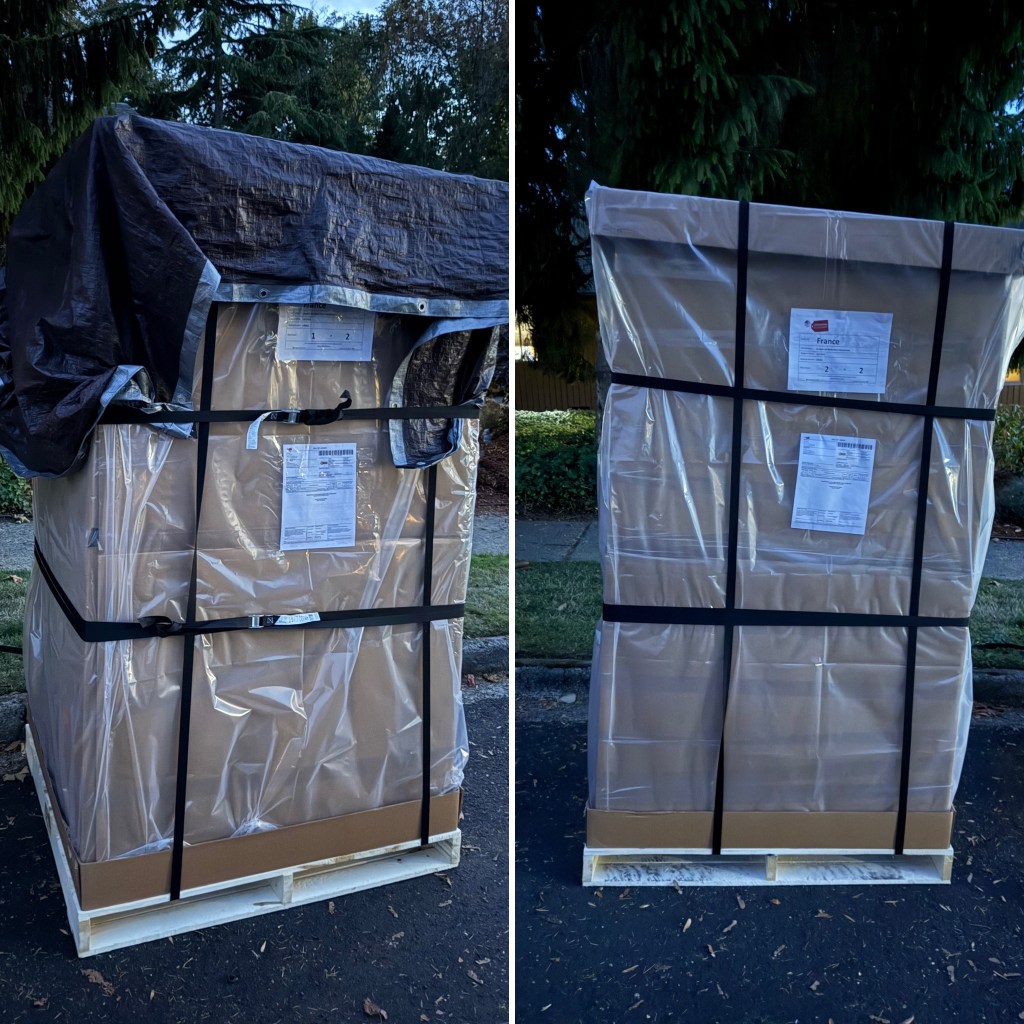
Vendors for this include UPakWeShip, UHaul International, and more. We chose the crate option, and our cost was about $4200 for two pallets – which worked out to be 45 boxes. Doing the math on that, it’s $27 per cubic foot of shipping space. That number was really important for us in curating what we decided to take, or not.
Disadvantages of this shipping method are slow (2-3 month) ocean freight shipping time, and potential wasted space if your shipment size doesn’t neatly fit into the standard crate dimensions. You are also limited in size of items shipped by the crate dimensions, pretty much ruling out furniture. You also need to be home all day for pickup and delivery, but it seems less restrictive with this shipping option.
Partial Container Shipping. It is possible to ship a partial shipping container without being constrained by pallet or crate size. You are able to estimate by your cubic feet shipped, and share a container with other customers choosing the same shipping option. You pack and label, your items are picked up by the vendor, and you provide the customs inventory. Your items are taken to a warehouse, where they are held until a full container load is consolidated. The container is sent to the nearest terminal, shipped via ocean freight, unloaded and deconsolidated, and clears customs. It’s then delivered to you at your home.
Many international shippers will support this option. We got a couple of quotes and they were comparable to the pallet shipment pricing.
Disadvantages of this method are potentially slow shipment consolidation time, as well as slow (2-3 month) ocean freight shipping time frame. I would also be concerned about shipment integrity and items going astray, but I suspect these shippers have it down to a science.
Full Container Shipping. Those who are shipping an entire household, including furniture, sometimes choose full container shipping. A shipping container is usually 8’W, 8’6”T, and either 20’ or 40’ L. For those who have a shipment that large, the cost per cubic foot drops dramatically (a friend calculated it out to be about $14/cubic foot, about half the cost per cubic foot of a pallet). Shipping flexibility for large items is excellent. Some folks will even ship a vehicle via container, but that’s not recommended for regulatory, inspection, and registration purposes.

This option can include a more full-service approach to packing, loading, shipping, inventory, unloading, and unpacking.
Your items are picked up and often loaded into your container, and your customs inventory is created at the same time. Your container is hauled to the terminal to await loading on a ship for the ocean crossing. The ocean crossing can be slow, and upon arrival items are unloaded and clear customs. They are then sent to the terminal to await transport to your home.
Disadvantages include the commitment to ship a lot of stuff, and potential wasted space if you only partially fill the container. We’ve also mentioned the slow (2-3 month) ocean freight shipping time frame.
Customs and Insurance
Customs information about relocating to France indicates that those moving to France can ship used (greater than 6 months old) personal possessions to France in conjunction with an international relocation for up to a year following the arrival date. There is paperwork required for that customs exception, both an attestation at the time of your shipment, and a certificate of relocation that you need to get from your regional French consulate.
In France, new items shipped, or items shipped outside that first year, are subject to customs and VAT tax. I believe there are some exceptions for inheritances, but I have not looked at those in details.
Other countries, even within the EU, may have different requirements, so check consulate and customs information specific to your country.
It is strongly recommended that you insure your shipment against loss or damage. You get to estimate replacement value for your items shipped, and a typical insurance cost is 2.5% of that replacement value.
Forbidden and Restricted Items
Many of the prohibited items on the basic international list are common sense, like Flammables, poisons, medicines, etc.
https://upakweship.com/community/moving-tips/prohibited-items/
There are some really interesting items specific to France that are worth reviewing.
https://www.sflworldwide.com/worldwide-destinations/shipping-to-france/restricted-prohibited-items
 House Snark